
TASHKENT – The leaders of the Central Asian states have formally admitted the Republic of Azerbaijan as a full member of their regional consultative format, effectively transforming the long-standing C5 into a C6 bloc focused on strategic connectivity. The historic decision was finalised during the 7th Consultative Meeting of Heads of State held in Tashkent on 16 November 2025. The accession marks a pivot for the region, moving from a confidence-building mechanism to a unified “corridor core” capable of co-authoring the rules for the Middle Corridor and trans-Eurasian transport networks.
From C5 to C6: A Historic Accession
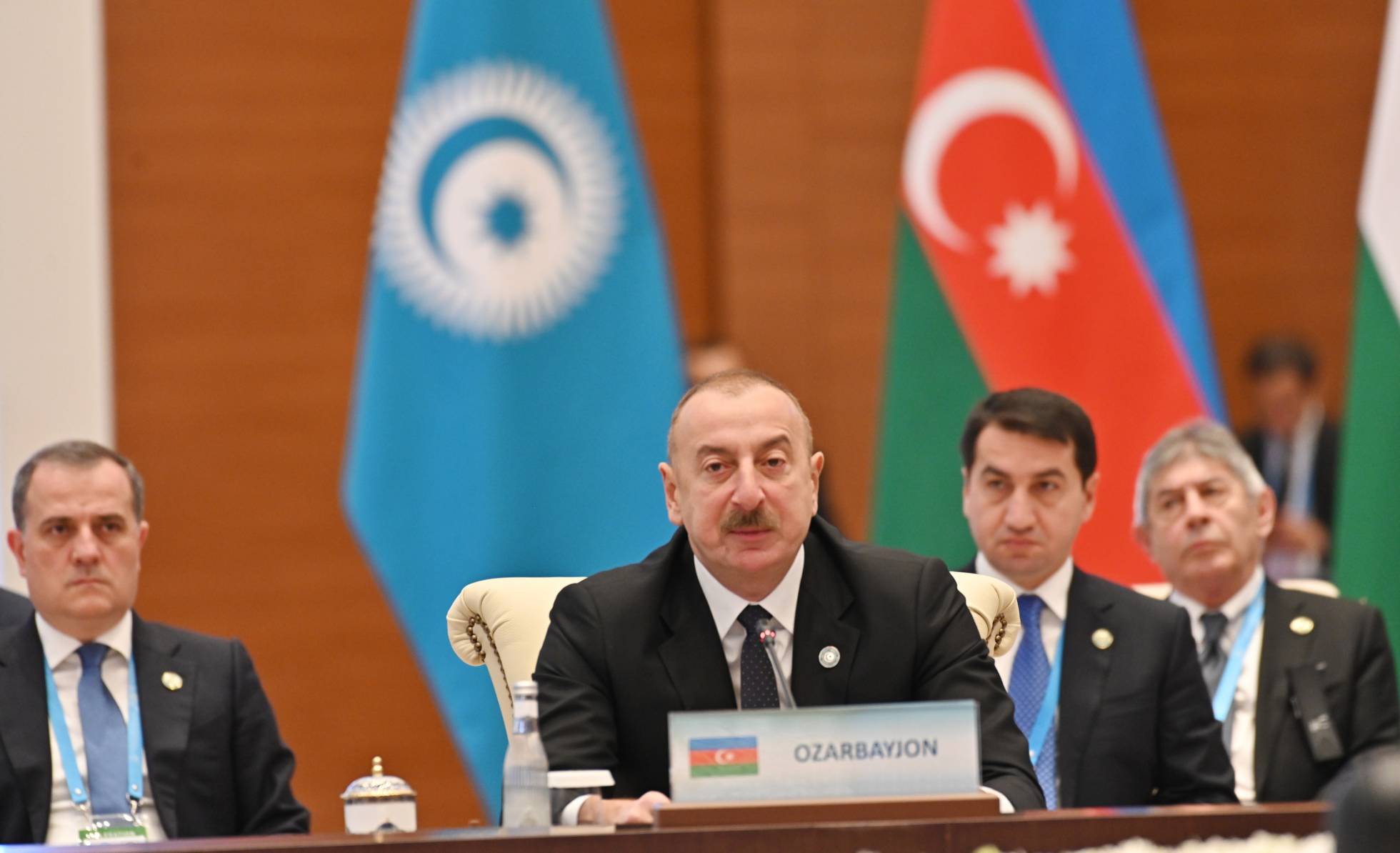
Hosted by Uzbek President Shavkat Mirziyoyev, the summit brought together the presidents of Kazakhstan, Kyrgyzstan, Tajikistan and Turkmenistan, alongside President Ilham Aliyev of Azerbaijan. While Azerbaijan had attended previous summits as a guest, this meeting marked its transition to a full participant with equal rights, a move unanimously supported by all member states.
President Mirziyoyev described the accession as a “truly historic event,” noting that the expanded format creates a single geopolitical space connecting Central Asia with the South Caucasus. To institutionalise this integration, the Uzbek leader proposed transforming the consultative mechanism into a formal “Community of Central Asia,” complete with a rotating Secretariat and a Council of Elders to oversee cultural dialogue.
Building the “Corridor Core”
The transformation into a C6 format signals a strategic shift towards operationalising the Middle Corridor (Trans-Caspian International Transport Route). According to analysis by The Times of Central Asia (Source 1), the inclusion of Azerbaijan allows the region to “co-author the agenda” of connectivity rather than merely adapting to external projects.
Key developments regarding the corridor include:
- Unified Transit Logic: The C6 geometry treats the trans-Caspian route as a joint asset, linking physical infrastructure with soft connectivity standards such as digital data flows and customs harmonisation.
- Strategic Autonomy: By formalising Azerbaijan’s role, the bloc aims to reduce reliance on external actors and establish its own regional rules for transport and logistics.
- Transport Strategy: Kazakh President Kassym-Jomart Tokayev proposed the joint drafting of a “Comprehensive Strategy for the Development of the Transport System of Central Asia,” explicitly anchored in the new consultative format.
Deepening Regional Integration
Beyond transport, the summit produced a roadmap for broader economic and security cooperation. Leaders agreed to develop a comprehensive regional programme for trade and economic cooperation valid through 2035 and to draft a declaration on a common investment space.
The deepening integration is also reflected in bilateral trade figures. According to Euronews, Uzbekistan’s trade with its Central Asian partners has doubled over the past five years, while its trade with Azerbaijan surged by 87,5 per cent in the first three quarters of 2025.
Security cooperation also featured prominently, with the leaders endorsing a concept of regional security and stability to coordinate efforts against transnational crime and cyber threats. President Aliyev emphasised that the security and stability of Central Asia and Azerbaijan are now interlinked, forming a unified zone of influence.
Concluding Outlook
The formal constitution of the C6 format represents a move from declaratory diplomacy to functional integration. By aligning the resource-rich Central Asian states with Azerbaijan’s critical transit geography, the bloc is positioned to become a primary stakeholder in East-West trade. The immediate challenge for the new Community of Central Asia will be to translate this political will into technical harmonisation, specifically regarding the digitalisation of customs and the unified management of the Middle Corridor.
In the context of the recent landmark agreements with North America, the Central Asian nations sent a clear signal of cooperative unity and ambition to take further developmental steps. However, the exclusion of Türkiye from the expansion and the recent developmental steps also show that the states are valuing economic and strategic progress over normative unity. Moreover, the expansion of cooperation in the C6 framework, despite the existence of the Organizations of Turkic States, spearheaded by Türkiye, endangers the importance of this forum.
Türkiye, in turn, revived debates about a closer cooperation with the European Union. With those developments, Turkic unity and integration might move farther away, although this would be the most effective and value-generating trajectory for national politics and international stability. Therefore, it is important for the Turkic nations to realign and work a cohesive strategy to avoid ineffectiveness and separatism through diversification of external partnerships.