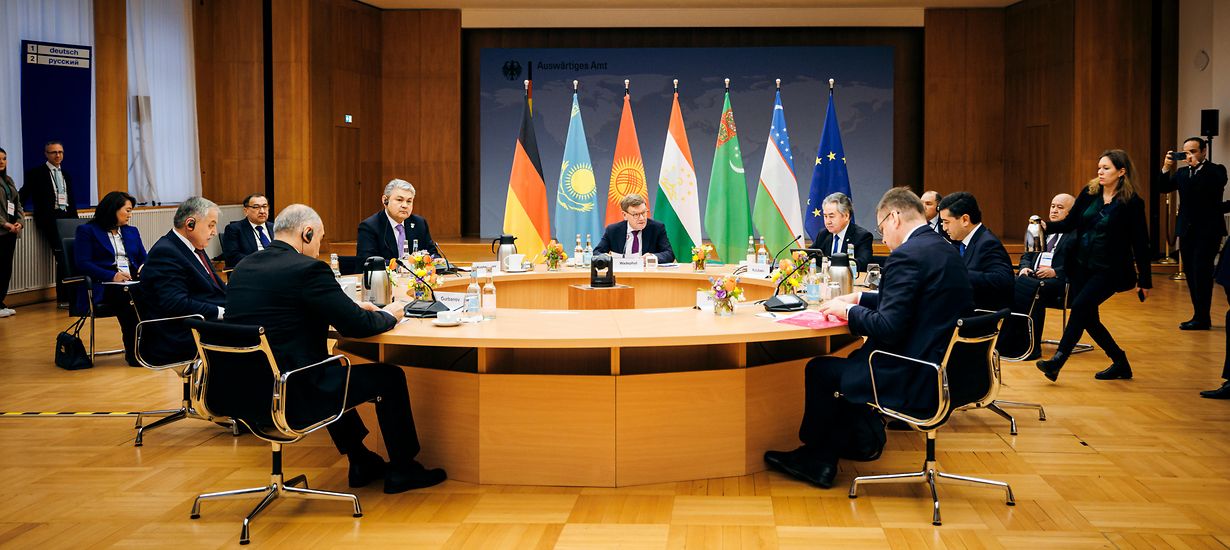

The five Central Asian states — Kazakhstan, Kyrgyzstan, Tajikistan, Turkmenistan and Uzbekistan — have consolidated their regional diplomacy by formalising cooperation with Germany under the new Z5+1 format. Meeting with German counterparts in Berlin on 11 February 2026, Central Asian foreign ministers endorsed a structured framework for political, economic and security dialogue, reinforcing their collective position as a coordinated regional bloc engaging major European partners.
The initiative builds on earlier high-level exchanges, including summits in Berlin (2023), Astana (2024) and Samarkand (2025), and reflects Central Asia’s growing practice of engaging external actors through unified regional formats.
Central Asia Shapes The Agenda: Economy, Connectivity And Energy
Advancing Trade And Investment
Central Asia is using the Z5+1 format to expand economic cooperation and attract diversified investment. Kazakhstan, as the region’s largest economy, highlighted expanded oil exports to Europe and broader energy collaboration, positioning itself as a reliable supplier amid global energy realignments. The region emphasised infrastructure connectivity, logistics corridors and renewable energy partnerships as central pillars of engagement with Germany. Hydrogen cooperation, raw material supply chains and industrial collaboration were identified as priority sectors.
Leveraging Strategic Resources
Central Asia’s mineral and energy reserves — including oil, gas and critical raw materials — underpin its strategic leverage. Kazakhstan in particular presented itself as a key supplier of energy and industrial inputs, aligning export ambitions with European diversification strategies. The region framed cooperation not only as trade expansion but as long-term industrial integration, with value-added production and technology transfer featuring in discussions.
Regional Coordination On Sanctions And Security
During the Berlin meeting, Germany called on Central Asian governments to strengthen cooperation on the enforcement of sanctions related to Russia’s war in Ukraine. Central Asian states responded cautiously, reiterating their commitment to international law while balancing complex economic ties with neighbouring powers. Rather than formally aligning with sanctions regimes, the region has emphasised transparency, regulatory compliance and avoidance of sanctions circumvention, reflecting a calibrated diplomatic posture due to historically close, though asymmetric ties with Russia. Beyond sanctions discussions, Central Asia placed regional stability, border management and counter-terrorism cooperation on the agenda.
Concluding Outlook: Central Asia As An Active Strategic Actor
The institutionalisation of Z5+1 reflects Central Asia’s multi-vector foreign policy approach. The region has established comparable engagement formats with the United States of America (C5+1), China, the European Union, Japan and Azerbaijan (C6), allowing it to diversify partnerships and mitigate overdependence on any single external power.
Especially due to the redirected foreign policy focus of Russia, the Central Asian nations face less intervention, which has led to more political stability since the war in Ukraine. In the past two years, the Central Asian nations have significantly increased international dealmaking with several new and old partners because of the lesser influence of Russia.
With the increased political stability and reliability, the Central Asian nations can now channel their focus on leveraging geographic and infrastructural power to gain capital for moving to higher developmental steps, such as technology and the services sector.
Especially, the following areas are leveraged to gain more political and economic traction:
- Diversification of energy exports and transport routes
- Expansion of renewable and hydrogen cooperation
- Selective alignment on regulatory and sanctions compliance
- Strengthening of regional political coordination mechanisms
However, there is an important risk that the Central Asian nations need to be aware of. The partners it has chosen to work with are mostly nations and regions known for socio-political invasion and infiltration. While the partnerships are viewed by Kazakhstan, Kyrgyzstan, Tajikistan, Turkmenistan and Uzbekistan as positive advancement developments, the counterparts, apart from Azerbaijan, might see them as opportunities to exert political influence in the context of their ongoing conflicts with China and Russia.
Therefore, it is very important that the Central Asian nations also accelerate international integration based on the common Turkic heritage to shield their citizens and political systems from malevolent external pressures.