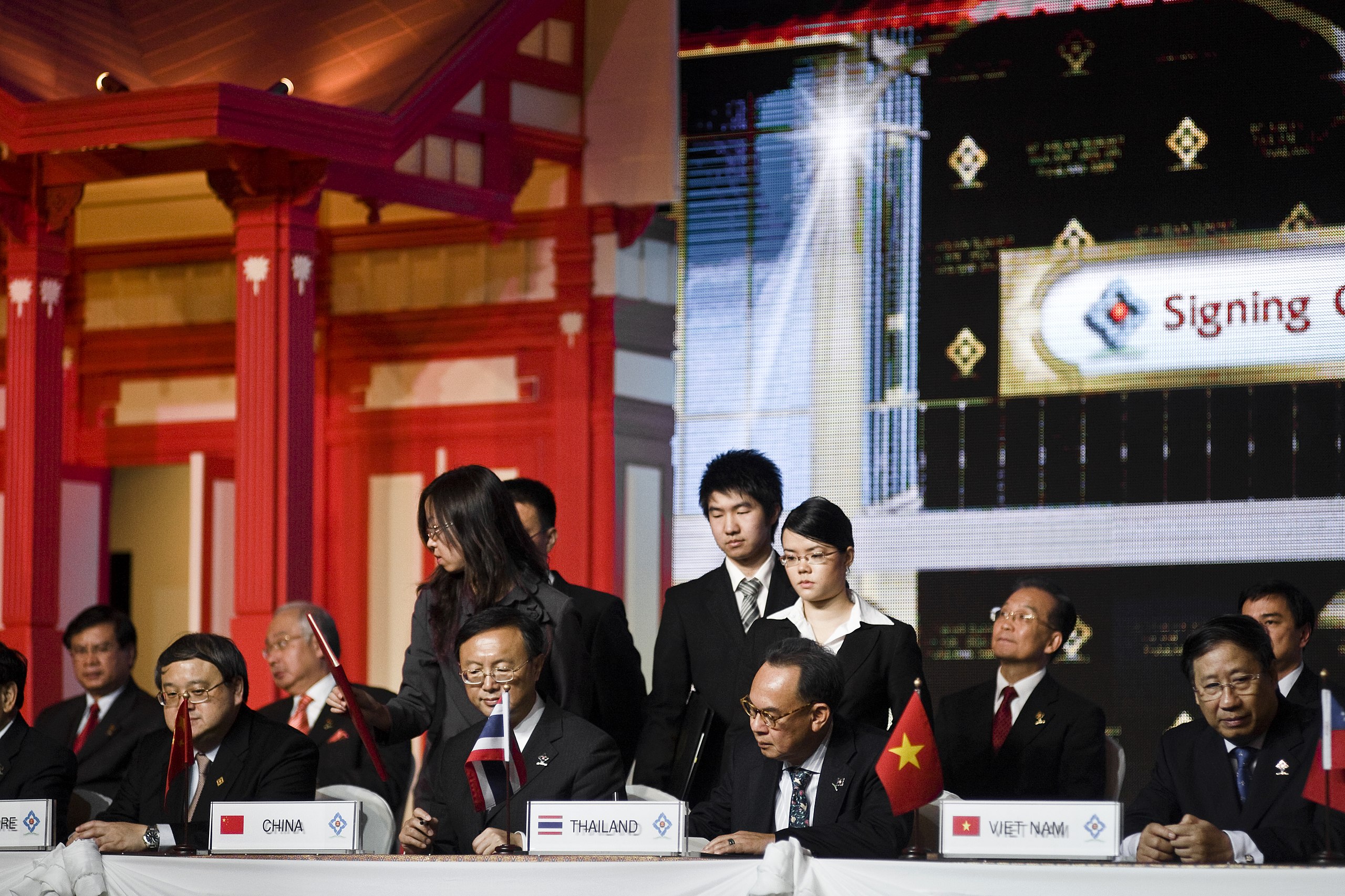

On 28 October 2025, the People’s Republic of China and the Association of Southeast Asian Nations (hereinafter: ASEAN) formally signed an upgraded Free Trade Agreement (hereinafter: FTA) in Kuala Lumpur, Malaysia. This enhanced pact, referred to as the ASEAN-China Free Trade Area 3.0 (ACFTA 3.0), is designed to deepen economic ties, strengthen regional supply chains, and expand cooperation into new strategic areas such as the digital and green economies. The finalisation of this agreement occurs at a time of rising global protectionist measures, particularly in the form of persistent tariffs imposed by the United States of America, positioning the pact as a strategic regional response to global trade friction (Reuters; Al Jazeera).
Details of the Upgraded Free Trade Pact
Enhancing Market Access and Strategic Cooperation
The newly signed agreement is an enhancement of the original 2010 FTA and is aimed at elevating the scope and sophistication of the trade relationship between China and the ten-member ASEAN bloc. The pact focuses on removing remaining non-tariff barriers, simplifying customs procedures, and improving the rules of origin to streamline regional trade flows (Channel News Asia; News.az). The core goal is to generate deeper market access for goods and services across all eleven economies.
Beyond traditional trade in goods, the ACFTA 3.0 systematically expands institutional cooperation into several key strategic sectors:
- Digital Economy: The pact includes new provisions designed to facilitate digital trade, encourage the free flow of data and establish a common framework for e-commerce, reflecting the growing reliance of both China and ASEAN on digital infrastructure for commerce.
- Green Economy: New chapters focus on cooperation in sustainable development, environmental protection and the reduction of carbon emissions, aiming to promote regional investment in renewable energy and green technology standards.
- Supply Chain Resilience: A major emphasis is placed on enhancing the stability and resilience of regional supply chains. The agreement introduces mechanisms intended to mitigate disruptions and ensure the continuous flow of essential goods among member states, thereby safeguarding economic stability.
The finalisation of this enhanced pact in Kuala Lumpur is expected to significantly increase the volume and complexity of trade and investment flows between China and ASEAN member states, collectively strengthening the institutional and economic linkage between the world’s second-largest economy and the dynamic Southeast Asian region.
Geopolitical and Economic Context
The signing of the upgraded FTA is viewed through the institutional lens of current geopolitical and economic competition. The commitment by China and ASEAN to deepen regional integration is interpreted as a strategic effort to consolidate economic stability against the backdrop of increasing protectionism from outside the region (Mid-day). Persistent trade tensions, particularly the maintenance of tariffs imposed by the United States of America on Chinese goods, have prompted a regional focus on bolstering intra-Asian commerce.
The ACFTA 3.0 reinforces the central role of ASEAN as a pivotal node in global supply chains. By committing to greater liberalisation and cooperation in new sectors, the bloc seeks to attract foreign direct investment and cement its position as an engine of global economic growth. The strengthening of regional trade frameworks, such as this agreement, is a direct strategic response by ASEAN member states to reduce their collective vulnerability to external political and economic pressures. The long-term implications of such large-scale regional agreements on global power dynamics and trade flows can be further assessed by consulting our previous work on global power shifts.
Concluding Forecast/Outlook
The signing of the upgraded China-ASEAN FTA marks a strategic milestone for economic integration in Asia, establishing a deeper institutional commitment to liberalisation. The immediate challenge for the bloc is the technical implementation of the new, more complex digital and green economy provisions.
The primary trajectory is that the agreement successfully accelerates regional economic growth by facilitating trade in high-value, digital and green sectors. By simplifying customs procedures and strengthening supply chains, the pact could solidify the ASEAN region as the most resilient and stable area for global manufacturing and commerce, potentially attracting investment away from regions facing higher political volatility or trade barriers. This would lead to a measurable increase in intra-bloc trade.
A challenge, however, involves managing the inevitable political consequences of greater economic dependence on China. While the pact offers substantial economic benefits, member states must balance these gains with the necessity of maintaining their political and strategic autonomy. The long-term success of the FTA hinges on ASEAN’s capacity to ensure that economic integration translates into shared prosperity and does not inadvertently increase internal political friction among its diverse member states.