
Continuing with the last work in our five-article series on the current war on Iran, we are adopting the strategic lens of Türkiye. In this article, we put ourselves in the position of the Turkish state to understand what it can do within this war. As Türkiye is multidimensionally affected by this war, we will look at a mix of different motivations and interests, as well as methods to achieve its goals. Without assessing the normative dimension of Türkiye’s strategy from an external perspective, we aim to create an understanding of its position and look at the war from its perspective.
The value and purpose of this series is to display our impartiality, flexibility, expertise and the strategic strength of our analytical framework. Usually, work in the political field is limited to cognitive and conceptual frameworks of ideologies and interests. With this series, we underline that politics can, and should, be approached from a technical angle to ensure that crafted measures truly reflect functional and sustainable solutions. It follows from the above that we are not inherently adopting the stances of the parties but merely adopting their lens for the purpose of our strategic analysis. This series must therefore not be read as a positioning from our side.
Türkiye’s Goals And Interests In This War
Since the founding of the Turkish Republic, its foreign policy has been characterised by a security-driven approach. Whereas the Turkish nation pursued a more expansionist foreign policy during the former Ottoman Empire, the political orientation of the state has been inherently inward-looking. Diplomatic behaviour is heavily focused on relationship management and mediation between states. Further, military operations in foreign nations, such as Syria, were also security and goal-oriented, as those operations only lasted a few weeks and ended with the proper restoration of peace with virtually no civilian casualties. As Türkiye pursues this peace and stability policy in foreign relations, including its mediation efforts in other contexts, we can see that this is born out of a highly violent international setting that Türkiye is affected by. From Georgia, over Armenia, Azerbaycan, Iran, Iraq and Syria, all bordering states have been involved or still are involved in massive military conflicts. Beyond those states, Ukraine, Israel, Lebanon and Crimea are also regions close to Türkiye where conflicts have emerged and continue.
Further, there have been several statements of Israeli politicians that outline Türkiye as a political threat, drawing rhetorical parallels to Iran from the Israeli perspective. These statements and cold-war-like diplomatic relations with Israel also point to a potentially direct conflict with Israel, if the Jewish nation truly aims for Türkiye. At the time of publication of this work, a temporary ceasefire between Iran and the United States of America (hereinafter: USA) was in place, which is acknowledged by Israel. However, Israeli incursions in Lebanese territory persist, which underline the expansionist aspirations of Israel, which, in turn, strengthens the assumption that Türkiye could be a potential next target for Israel. Additionally, the USA have now repeatedly put a potential exit from the North Atlantic Treaty Organisation (hereinafter: NATO) on the media agenda, which would be a necessary prerequisite for them to join Israel when attacking Türkiye.
It follows that, in this war, the primary goal and interest of Türkiye is twofold. First, a sustainable end to the war, followed by a lasting period of peace and socio-economic reconstruction of its neighbouring states. This is in line with Türkiye’s long-term interests, as the constant wars in the region naturally have had spillover effects on the Turkish economy, including opportunity costs, as well as developmental disadvantages, as the bordering regions suffer from security concerns, which hamper growth in all aspects. Second, Türkiye has an inherent interest in quickly expanding its military capabilities to be prepared for potential aggressions by Israel and the USA. Although Türkiye has historically had one of the strongest armies in the world, it needs to be assumed that the Israel/USA axis is going to be more prepared when attacking others in the future, due to the significant loss in the recent war with Iran. Therefore, military build-up should be paramount in Turkish foreign policy in the coming years.
Türkiye’s Strategy To Achieve Its Goals
Military Strategy
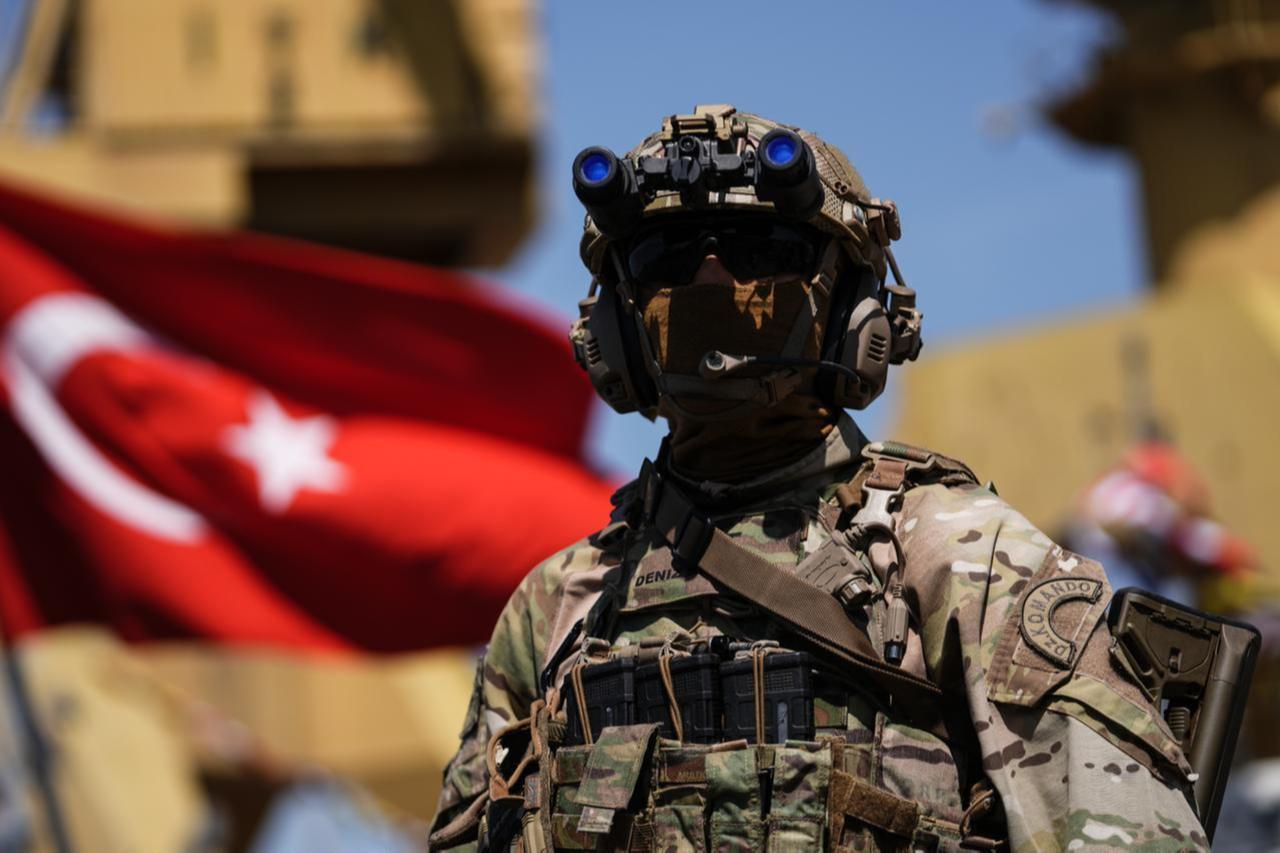
The main pillar of Türkiye’s military build-up is its national defence industry. As of 2026, the Turkish military consists of more than 80% domestically produced and developed content. This number signals that Türkiye is close to military autarky, which reduces a significant amount of supply chain and production problems in the event of a war. In terms of technology, Türkiye is already producing high-end military technology, primarily focusing on unmanned aerial and naval military vehicles. Further, its domestic aircraft carrier, vast firearms companies, armoured vehicle producers, deep military experience as an organisation, highly skilled soldiers and domestically developed fighter jet build a comprehensive landscape of military capabilities. However, there are three factors that Türkiye needs to focus on excessively to easily fend off foreign aggression. First, the production capacity of Türkiye, as of today, remains limited. While there is domestic technology in its most sophisticated form, there is a considerable deficit in Türkiye’s capacity to produce these technologies in great volumes within a short amount of time. This means that in the event of external aggression, Türkiye can defend itself to a certain point, but would face difficulties in keeping up the stocks of weaponry when they start to deplete.
Secondly, in terms of missile systems, Türkiye is lagging behind in the international comparison. Neither is the technology as advanced as it is, for example, in the field of drones, nor are there expansive production capacities. As modern warfare is increasingly relying on missile attacks, advancing in the field of missile systems in attack and defence is paramount to complete Türkiye’s already strong military. Especially, this element could be a point where external aggressors might focus on. This leads us to the third focal point of Türkiye’s military strategy: military intelligence. As an open and interconnected nation, we must assume that a large number of spies and agents are currently deployed in Türkiye to track developments in the defence industry, and maybe sabotage these. In many cases, Türkiye is an open book with its decentralised economy and society at the crossroads of two continents. Counterintelligence and cracking down on foreign intervention networks need to be intensified and rigorously executed to prevent valuable information from leaving the nation. Also, these agent networks, as well as more indirect networks in business and media, are installed in Türkiye to achieve detrimental societal developments to demoralise the Turkish society; we will look at this aspect later in the section on Türkiye’s Societal Strategy.
Diplomatic and Political Strategy
At the core of Türkiye’s political strategy must be to regain collective cohesion domestically and normative authority in the diplomatic arena. Over the past two decades, the Turkish society has been increasingly divided along political lines. With the ruling party’s focus on furthering Islamic sentiment, opposition parties drifted into radical liberalism, both of which led to the decline of Pan-Turkism, which is the core of the collective essence of the Turkish society. This, naturally, has led to ineffectiveness in policymaking as political actors today mainly focus on maintaining and expanding their and their parties’ powers by counteracting their respective opposition and the underlying notion of Pan-Turkism. To be prepared for external aggression, political cohesion is very important as it saves valuable transaction costs in the form of time and accuracy in the implementation of orders.
Diplomatically, Türkiye needs to create the ideal environment for foreign support in the event of war, based on its core societal trait: normative authority. While Israel’s societal fabric is located at the lower end of normative authority, due to its demonstrated flexible and vastly stretchable moral boundaries, Türkiye already has a reputation and history for being morally grounded, balanced and mature. However, this reputation has been challenged by different dynamics in the past decades. For one, foreign actors tended to approach Türkiye quite differently, depending on their interests and stances at a given time. For example, during the Operation Euphrates Shield, European nations, especially Germany, ran comprehensive diplomatic campaigns against Türkiye. However, during Operation Peace Spring, which was nearly identical in approach and goal, those very nations supported Türkiye, or at least remained neutral. It follows that it is not necessarily the actions of Türkiye that define diplomatic stances but situational factors, which makes the establishment of sustainable moral authority more difficult. Further, the political divide domestically has given foreign nations much material to undermine Türkiye’s moral authority. Therefore, the diplomatic strategy of Türkiye to gather support to a point where allies might join Türkiye in the event of an attack, or at least prevent affluent nations from joining the aggressors, must centre around the approach of increasing the visibility of the moral distance between Türkiye and Israel. Especially, public diplomacy becomes important here to increase international legitimacy.
Iran and Russia Relations
The first partners Türkiye needs to strengthen ties with are Iran and Russia. As those nations are affluent, militarily strong and already outspoken opponents of the USA and Israel, they are likely to also support Türkiye. Further, those nations are aware of the political implications of a destabilised Türkiye for their domestic politics and long-term outlook in the region. Therefore, there is already an intrinsic motivation to support Türkiye in the event of an outside aggression, at least in terms of supplies and technology. However, Türkiye has neither supported Russia nor Iran in their struggles against Ukraine and Israel/USA, respectively. There could have been the expectation of both nations to support them in their conflicts, but Türkiye voiced its sympathy and/or support only as much as it perceived it could to remain neutral. This factor will also be the main reason for the limited involvement of Iran and Russia when Türkiye is attacked.
Turkic Relations
For the Turkic nation, stretching beyond the borders of Anatolia, the Central Asian Turkic societies and states are extremely important. Although this one race is divided along different territorial and political lines, there are still deep-rooted ties and inherent sympathy among all involved states. Gaining support from the Turkic nations is paramount, also beyond the context of potential aggressions. However, military support is quite unlikely as the Central Asian nations have currently built important economic and infrastructural dependencies with the USA. As the USA now have significant leverage over those nations, supporting Türkiye in a constellation in which Israel attacks Türkiye with the support of the USA would lead to serious economic and potentially political crises in Central Asia. Even in purely symbolic matters, such as the recognition of the Turkish Cypriot Republic, the Turkic nations of Central Asia sided with the Europeans. Therefore, the strategy here must be thought more long-term, with only minimal expectations of support from the blood brothers in Central Asia.
Europe Relations
As regards Europe, Türkiye’s premise cannot be to gain support in defending Anatolia but rather to achieve non-involvement and neutrality from Europe. Although most of Europe is part of NATO, the cultural, racial and ideological proximity between European nations and their grandchildren, the USA and Israel, is too high and significant to abandon it to honour a defence pact for a Turkic nation. In particular, if the USA are exiting NATO, the organisation will quickly understand the intention behind the move and try to dissolve itself, in order to avoid the situation of having to legitimise why it will not rush to Türkiye’s defence. When Türkiye runs vast and sophisticated media campaigns to underline its moral superiority over Israel, it will enjoy public support in Europe. NATO will then necessarily dissolve before any attacks on Türkiye to avoid domestic unrest. All of that needs to be calculated and accepted by Türkiye. The aim in terms of European relations should not be to receive help from the European governments, but rather the emotional support of the European public.
Global Public Relations
Internationally, the same goal applies with the difference that international help can be expected in the form of diplomatic and economic support. North Africans are likely to support the Turkish defence, Egypt and Libya in particular. If necessary, military support reaches Türkiye from Egypt, and some of the problems in terms of production capacities can be solved quickly. The same applies to support from China. China would have an interest in Türkiye’s defence because of the changing global power dynamics if Türkiye is destabilised, but as both nations entertain historically antagonistic relations, Chinese support will be limited and also not really welcomed in Türkiye. Ironically, the best support Türkiye can globally get is from the USA’s population. As a nation with intense media usage, running sophisticated branding and legitimisation campaigns can intensify the dissent in the North American public to exert domestic pressure on its government. However, the foundation for such dynamics needs to be built today.
Economic Strategy
Türkiye’s weakest point is its economy. Being in a prolonged economic crisis, the financial options are limited. As the crisis continues, the resolution, which requires socio-economic infrastructure, will take many years. Further, Türkiye has very little government debt, which is one of the few advantages of the Turkish economy, giving the Anatolian nation some degree of independence. However, this should not be sacrificed for the sake of survival. To react to an attack, the economic strategy in such a scenario needs to be a bit unconventional. As Türkiye’s strategy strongly evolves around Pan-Turkism and moral authority, the mobilisation of a free workforce in the form of the whole population is the central key to keeping production running at high levels. This has been done many times before in Turkish history (last time during the War of Independence), and history shows that this never led to societal chaos or exploitation. Accordingly, the economic factor can be ignored almost completely, as Türkiye can draw on a very special trait of its people in such an extreme scenario.
Societal Strategy
As mentioned a few times above, the main aspect on the societal side is the resurrection, strengthening and operationalisation of Pan-Turkism (or also Turanism) in Anatolia and beyond. It is the single most effective theme for Turks to mobilise their potential in economic, societal and political terms. As patriotic traditionalism is located at the very top in Turkish culture, it is an unquantifiably more solid societal fundament than Islam or political ideologies. In the Turkish strategy, Pan-Turkism needs to become the main state policy theme, as it informs policymaking in all areas on the basis of high moral authority and societal stability. It fills the gaps that arose with the political divide, enhances the effectiveness of the outlined diplomatic strategy and might even have the potential to increase economic efficiency and effectiveness beyond crisis, as it realigns economic conduct with the moral core of Turkish society. In the long run, such a policy orientation will inevitably also aid the Pan-Turkic integration with the Turkic states of Central Asia.
Final Remarks
Although we have examined the situation in the necessary depth, we stress that there are still many more policy options available to Türkiye at more micro-levels of policymaking. These options, however, fall more into the category of tactics, as opposed to strategy, which is the focal point of this work. Moreover, it needs to be stressed that we are examining this topic from a perspective of limited informational resources. From what is available, we conclude that the above strategy would enable Arabia to achieve its goals. It is also very important to consider the limitations of political actors. These can be in terms of resources, normativity or structure. Therefore, the assessments above should also be read in light of those real-life constraints of the said actors.
Finally, with this work, we are closing our series on the 2026 Israel-USA-Iran War that has had far-reaching implications for international politics and the surrounding actors, as we could see. At the time of publication, a temporary ceasefire has been implemented between the main actors, likely to replenish stocks. We expect further hostilities towards Iran by Israel and the USA in the coming weeks, months and years. After that, or potentially even before that, we also expect the axis to attack Türkiye.
This series has underlined that we can adopt different stances and view politics through every actor’s lens. When we make statements and forecasts, this means that we have already screened all sides and scenarios and can communicate the final verdict. Are we always right? No, but very often. This is due to our sophisticated analytical approach. Most importantly, however, we always aim to utilise this approach to craft meaningful and sustainable solutions and development paths in politics with the goal to advance society – regardless of which society we are talking about.