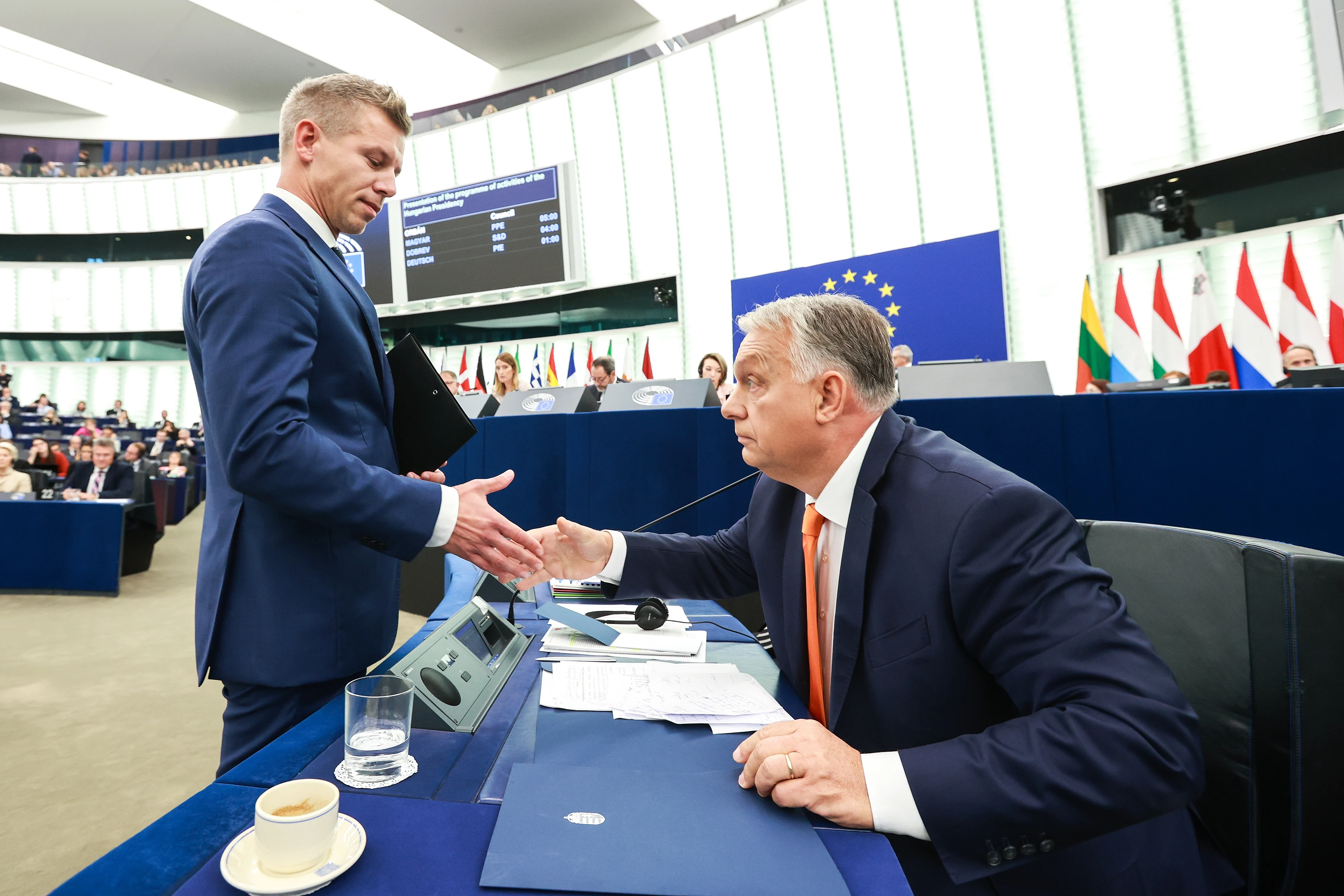

Péter Magyar’s Tisza party secured a two-thirds majority in Hungary’s parliamentary elections held on 12 April 2026, ending Viktor Orbán’s 16-year tenure as Prime Minister. With votes counted in 97,35% of precincts by early 13 April, Tisza obtained 138 seats in the 199-seat parliament with 53,6% of the vote. Orbán’s Fidesz party won 55 seats with 37,8% of votes. Voter turnout reached 77,8%, the highest recorded in Hungary’s parliamentary elections.
Electoral Results and Immediate Aftermath
Viktor Orbán conceded defeat after 45% of votes had been tallied on 12 April. Magyar, 45, addressed tens of thousands of supporters gathered along the Danube River in Budapest on Sunday evening, stating that truth had prevailed over untruth. He acknowledged that Hungarians had asked what they could do for their homeland rather than what their homeland could do for them.
Magyar’s victory speech occurred as supporters chanted “Ruszkik haza”—meaning “Russians, go home”—the slogan associated with Hungary’s 1956 revolution against Soviet control. The two-thirds supermajority provides Tisza with constitutional amendment authority, enabling the incoming government to modify institutional structures established during Fidesz’s tenure.
Voter Mobilisation and Turnout
The 77,8% turnout represents a substantial increase from the 62% participation recorded in Hungary’s 2022 parliamentary elections. Hungarian election officials reported that by 15:00 local time on 12 April, voter participation exceeded 66%. Magyar thanked 50.000 Tisza activists who served as election observers and stated that individuals engaged in electoral fraud would face legal accountability.
Péter Magyar’s Background
Born in Budapest in March 1981, Magyar obtained a law degree from Pázmány Péter Catholic University near Budapest in 2004. His great-uncle Ferenc Mádl served as President of Hungary from 2000 to 2005, overlapping with Viktor Orbán’s first term as Prime Minister between 1998 and 2002. Magyar joined Fidesz whilst at university when the party was in opposition following the 2002 election.
In September 2006, Magyar provided legal assistance to Fidesz on a pro bono basis during anti-government protests against Prime Minister Ferenc Gyurcsány. That same year, Magyar married Judit Varga, who later served as Orbán’s Justice Minister between 2019 and 2023. The couple has three children and divorced in 2023.
After Fidesz returned to power in 2010, Magyar received an appointment as an official in the Foreign Affairs Ministry. Between 2011 and 2018, he served in Hungary’s Permanent Representation to the European Union in Brussels. Upon returning to Hungary in 2018, he joined the board of directors of state-owned road operation company Magyar Közút ZRT and became head of the government’s student loan provider.
Break with Fidesz
Magyar’s relationship with Fidesz deteriorated following revelations in February 2024 regarding a presidential pardon granted to a man convicted of concealing sexual abuse in a children’s home. Former President Katalin Novák had authorised the pardon in 2023, with Varga signing the document as Justice Minister. Public protests erupted after the scandal became known. Novák resigned as President, whilst Varga stepped down from her parliamentary seat.
In March 2024, Magyar published a Facebook post accusing Orbán’s government of corruption. He also released a recording of a January 2023 conversation with Varga in which she detailed attempts by aides to Orbán’s cabinet chief to interfere in the prosecution files of a corruption case. Magyar subsequently joined the centre-right Tisza party in April 2024 as a candidate for the European Parliament elections. He won a seat representing Tisza and subsequently led the party into Hungary’s national elections.
International Reactions
Magyar has conducted telephone conversations with European Commission President Ursula von der Leyen, North Atlantic Treaty Organisation (hereinafter: NATO) Secretary General Mark Rutte, German Chancellor Friedrich Merz and French President Emmanuel Macron. These communications indicate his European and transatlantic orientation. As Orbán is an outspoken opponent of the European Union’s Ukraine policy, the initially warm stances from the European neighbour are informed by the hope to see a shift in Hungary’s international stance on Ukraine.
United States of America Response
The government of the United States of America (hereinafter: USA) had actively supported Orbán’s campaign. The Vice President visited Budapest on 7 April to campaign alongside Orbán, whilst Secretary of State Marco Rubio also travelled to Budapest during the election period. The President participated in campaign events via telephone. These interventions represented a departure from the typical USA practice of media intervention or massive funding of supported candidates.
Policy Promises
Magyar has pledged to revive Hungary’s economy, which has experienced stagnation since early 2022. He committed to reducing Hungary’s dependence on Russian energy by 2035 whilst maintaining pragmatic relations with Moscow. Magyar stated his intention to access approximately 18€ billion in European Union funds frozen due to Hungary’s alleged failure to meet bloc conditions for financial support. Magyar indicated that Hungary would join the European Public Prosecutors’ Office, an institution from which Orbán’s government had remained absent. He has emphasised intentions to restore independent media and judicial independence, both of which experienced constraints under Fidesz governance.
European Union Relations
Magyar’s government is expected to remove Hungary’s veto on the European Union’s 90€ billion support package for Ukraine. Under Orbán, Budapest had blocked multiple European Union initiatives, including loans to Ukraine, sanctions against Russia and energy security measures. In March 2026, Orbán had blocked a previously agreed 90€ billion credit to Kyiv related to a dispute concerning the Druzhba pipeline. Whilst Magyar represents pro-European Union positions, he has expressed reservations about Ukraine’s immediate European Union accession, arguing that the integration process should not be rushed. This position places him at variance with Kyiv’s preferences regarding the timeline for European Union membership.
European Union officials have adopted cautious approaches to engagement with the incoming Hungarian government. Analysts note that excessively swift release of frozen European Union funds without meaningful reforms could generate populist backlash across the bloc. The European Union must balance support for Hungary’s democratic transition with maintenance of standards regarding the rule of law and anti-corruption measures.
Domestic Challenges
Magyar faces substantial obstacles in implementing reforms. The Fidesz system, created over 16 years, includes entrenched allies across government institutions, state-controlled media networks and politicised judicial structures. The two-thirds parliamentary majority provides constitutional authority to dismantle these structures. Hungarian society identified the government itself as the primary concern in recent polling, making Hungary one of 11 such states among 138 polled globally. Economic stagnation represents Hungarians’ second priority.
Concluding Outlook
The Hungarian elections underline that democratic activity, especially in Europe, is still alive. The voter turnout and majority result stay in sharp contrast to declining political interest in Europe. Accordingly, Hungary has shown that democratic flexibility and mobility are there when citizens feel they need them. With Magyar’s victory, the expectation is a stronger national alignment with Hungarian core values, as the main aspects of criticism of the Orbán government can predominantly summarised under the umbrella term of political misconduct.
Further, Magyar’s political past shows that politicians who are long in power tend to fall into goal displacement and stagnation. Therefore, Magyar’s election can be a suitable chance for Hungary to adapt its policy course naturally and without falling into a situation of weakness first. If Magyar manages to bridge the domestic and international challenges, without being target to foreign intervention, Hungary’s path of growth remains intact.