Is there a shift in international power dynamics? A question that may seem obvious to answer at first glance, yet it becomes more difficult to explain the deeper one delves into the topic. For example, an analytic approach of evaluating quantitative metrics to identify potential shifts in power relations, such as examining economic data of two states, could provide an illustration of the status quo rather than an insightful understanding. Shifts in international power dynamics are, for instance, the result of long-term sociogenetic processes shaped by complex social, economic and political developments. Therefore, a targeted structural analysis must begin by isolating specific events from this broader spectrum, turning them into isolated objects of observation. This process of isolation enables a more in-depth analysis of the underlying mechanisms, making it possible to interpret them through the lens of foundational theoretical frameworks and theses. Since theoretical concepts often tend to be highly abstract or too general, applying them in concrete cases becomes essential. This paper focuses on the mechanisms, circumstances and conditions that enable a state to develop a monopolistic position of power, as well as the counter-mechanisms that lead to a decline in development once a state proceeds with the establishment of such a position.
If the analytical objective refers to a shift within a dynamic process, then the act of isolation must be a specific period of time in which the mechanisms of the shift become observable. Accordingly, there must be an initial situation, the status quo, which is the object of the change. The isolated objective of this analysis is the ascending development of the United States of America (hereinafter: the USA) and the mechanisms that led to their establishment of a relatively superior power position, one that enabled them to pursue their national interests with significant dominance. The initial starting point has to be in the period when the USA enforced its power ambitions on a global scale. Here, we assume that their intensification of pursuing geopolitical goals started after the Second World War. For the past (at least) seven decades, the USA have been the most dominant and influential actor on the geopolitical stage, displaying a power position in which the capacity of pursuing the constructed/perceived state interest of the USA was superior to all other nations. Especially after the failure of the Union of Soviet Socialist Republics (hereinafter: the USSR) in 1991, which was heavily influenced and targeted by the USA and its allies — e.g., through warfare, economic warfare or intelligence operations — there was no geopolitical counterpart left that had comparable power to the USA. While the USA could not, and still cannot, pursue their interests without geopolitical partners and, furthermore, not without any limitations (e.g. the Vietnam War forced the United States to concede its first major military defeat), for a significant period, other nations were not able to develop a similar power position. Yet, there must be factors that allowed the USA to create such a position, and furthermore, there must be factors that influence the descending trend in terms of their power discrepancy in the international context. In relative relationships, as geopolitical power is measured by comparison, descending power equals an increasing counterpart, here China, which will serve as the comparison for this analysis.
Monopolistic Situation and the Atatürk Paradox
While observing political dynamics through the lens of theoretical ideas, it is important to remind oneself of the limitations of this approach. It is necessary as it helps to fulfil one’s perspective of a subject, but such perspectives only capture parts of the larger picture and must therefore be understood in relation to the overall context. This first part is structured around three essential aspects. Initially, it is necessary to anchor the situation into a structural context and emphasise the reasons a state is aiming to achieve a dominant position. Second, the analysis examines the dynamics a state creates by achieving a monopolistic position. Finally, it addresses why a state seems to reach a point of saturation, or in other words, why the state is not able to increase the established power discrepancy.
A monopolistic position is a fundamental power dynamic where one actor holds significant dominance over others. To establish such a position do not have to stem from imperial ambition, but from a pragmatic need to create an advantage that preserves existing status, wealth or even survival. This dynamic is best illustrated by the relationship between a lord and his warrior followers in medieval societies (Norbert Elias, 1976). This system was built on mutual dependency: the lord required his followers for military power, while the followers depended on the lord for rewards, chiefly land and protection. Crucially, this balance of power was only stable as long as expansion was possible. In times of stagnation, however, the lord’s value proposition disappeared. Unable to offer new land or opportunities, he witnessed the rise of centrifugal forces as his followers’ loyalty decreased, eroding his influence. Ultimately, the lord’s monopolistic hold on power would collapse, demonstrating that such dominance is not static but requires constant expansion to counteract the natural decay of dependency. Following this logic underlines the cascading effect of those dependencies, as achieving a monopolistic position on a hierarchical level does not result in a static situation; the struggle for dominance shifts upwards. An actor achieves a power position in an arbitrary hierarchical position, only to encounter an equal rival on a higher hierarchical level. In today’s world, this holds true for both economic and political realms, with a slight difference in the magnitude: within nation states, hierarchical fights in the political realm have mostly been resolved and constituted in the sovereignty of the state, while on rare occasions, those internal fights have not been solved yet. In the economic realm, fights for monopolistic positions take place on all hierarchical levels.
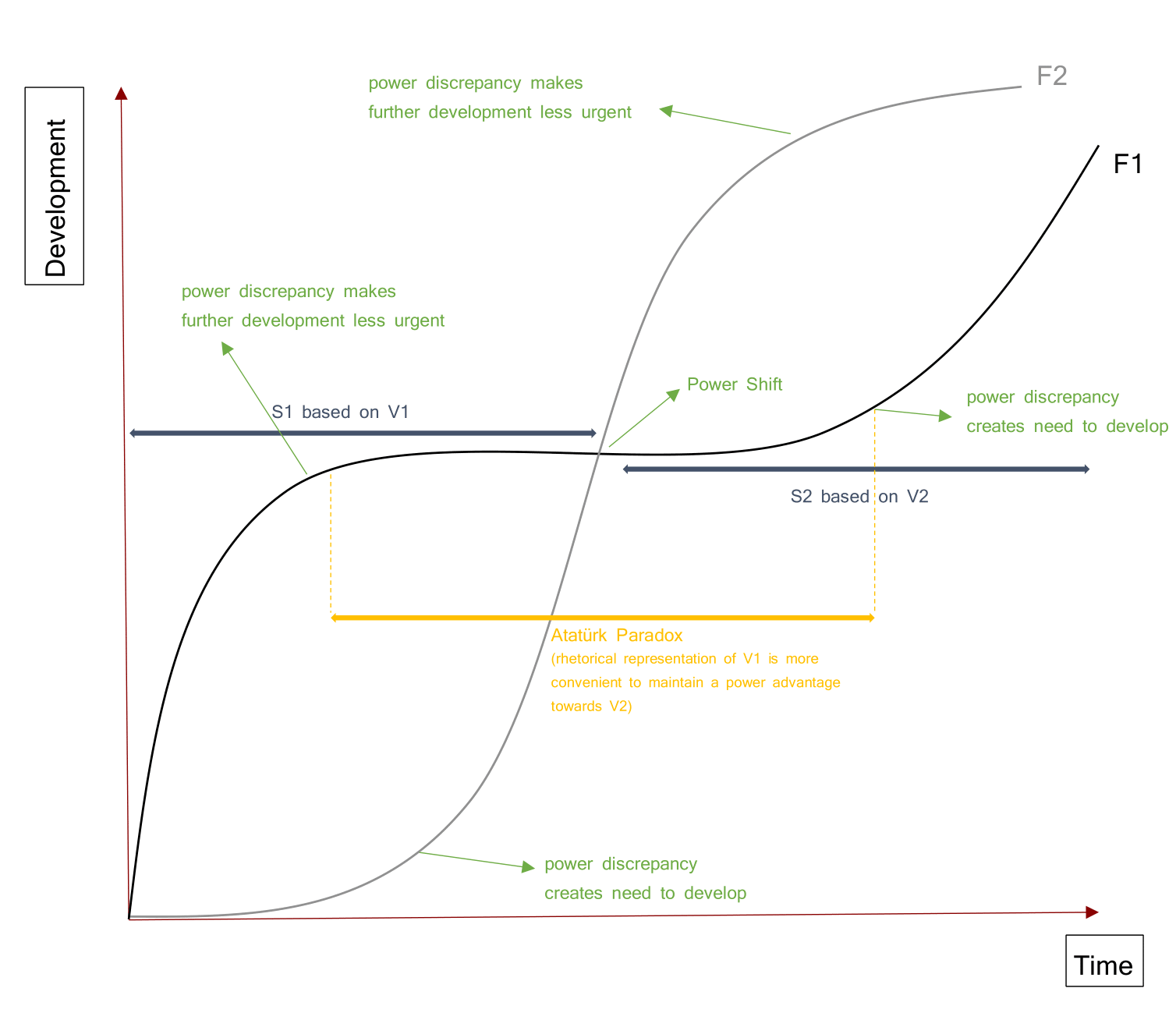
The monopolist, whether a state or an economic actor, holds the crucial capacities, be it production facilities, patents or strategic infrastructure. Consequently, other individuals or groups have significantly less access to these resources. While access is not entirely restricted, it is limited, leading to dependency between those without access – they become dependent on those who control the capacities. On the other hand, this dependency is not one-sided, as monopolists also rely on dependent groups to maintain and operate their systems. In such a society, where chances and access become restricted, social and economic mobility diminishes. Class structures become entrenched as opportunities become less accessible to groups with less power. These dependencies contribute to the consolidation of monopolistic power positions. In turn, this stalemate influences socio-cultural behaviour. Social values and behaviour begin to adapt and reinforce the static nature of the structure. Society becomes less dynamic and loses both flexibility and adaptability. This development can also be understood as path dependency. As institutions and social behaviours solidify, initial conditions and early decisions shape the possible future pathways a society can take. Some dependencies may be functional, supporting stability and coordination. Others, however, become dysfunctional, leading to inefficiency, stagnation and a loss of innovative potential. But even if the dependency is functional, the result will be in maintaining the position, which is a possible explanation for a stagnation in development at a certain point of saturation.
On a larger scale, the geopolitical landscape, these mechanisms also influence dynamics between nations. Nations with fewer capabilities rely on powerful states (e.g., security, resources, etc.) while powerful states need partners to pursue their interests. Those dynamics start with smaller partnerships, but the greater the ambitions of one actor become, the more the number of partners and counterparts shrinks, eventually leading to bloc formations, where mutual dependencies become apparent, in which only two sides remain (Unipolarity vs Bipolarity vs Multipolarity). We experienced such dynamics in the Cold War. As an example in context of the interplay of the USA and the USSR serves the containment strategies of the USA in the Cold War, which were solely practicable through the partners of the USA, e.g. by placing PGM-19 Jupiter missiles in Türkiye in the early 1960s, directly threatening the USSR and creating a dominant position that would not be possible without a partnership. Thus, the necessity for dependencies is the main factor why a state cannot continue to expand the power discrepancy with relatively powerless states. Why? Because once an actor reached the ambitiousness goal of an overwhelming power position the dependencies that were allowing him to pursue this, by providing resources, security and parts of their own power – being partner of a hegemonic power creates an improved position to pursue your own state interests – now becomes a burden when there are less benefits for the partner states. The centralisation of power by the hegemonic state begins to erode when the necessity for the partner states to remain in those dependencies decreases. Without mutual benefits, the incentives for remaining subordinated to another state weaken. On the other hand, the power of the hegemonic states relies on the partner states; their focus must switch to maintain the status quo in order to compensate for the centrifugal forces that affect the centralisation of power. This dynamic can be visualised and complemented by the Atatürk Paradox; a theoretical context that has been discovered by Emre Şentürk within an analysis of socio-cultural behaviour in Turkish society. The analogy lies in an emerging point of saturation, a phenomenon that has a repeating pattern in societal structures.
Over the past four decades, the USA have remained a global leader in technological innovation, particularly in fields such as artificial intelligence, biotechnology and software development. Much of this progress, however, has been driven by the private sector, while public investment in foundational research has stagnated or grown more slowly. This shift from state-funded basic research to application-oriented, market-driven research & development (hereinafter: R&D) reflects a broader strategic orientation: maintaining global dominance through military superiority, trade policy and selective protectionism. Social inequality has increased significantly, with declining social upward mobility, unequal access to education, rising student debt and weakened labour rights reinforcing a more static social structure, underlining the inflexibility. Public infrastructure has suffered from underinvestment, with outdated systems only recently addressed by the 2021 Infrastructure Investment and Jobs Act. In education, high overall spending contrasts with poor outcomes in equity and efficiency: locally unequal school funding and increasing college costs continue to restrict opportunity. In short, while the private sector in the USA has continued to innovate technologically, its broader landscape of social policy, public investment and infrastructure reveals a pattern of strategic neglect, shaped less by growth and more by efforts to maintain the status quo.
Those effects become more significant when we highlight two crucial sectors that could reveal the nature of a closed society. Public spending on education as a percentage of GDP has remained relatively stable, around 4,9% in 1980 and again in 2019 (OECD, NCES). However, the cost of higher education has significantly increased. For example, average inflation-adjusted tuition and fees at public four-year institutions for students rose from approximately 4.160$ between 1980 and 1981 to about 10.940$ in 2022 and 2023 (College Board, “Trends in College Pricing”). This surge in costs has contributed to a massive increase in total student loan debt, which grew from roughly 187$ billion in 2003 to over 1,7$ trillion by 2023 (Federal Reserve Bank of New York). In terms of international comparisons, the USA 15-year-olds’ scores in the Programme for International Student Assessment (hereinafter: PISA) in mathematics have shown a decreasing trend. While the USA scored 483 in 2003, below the Organisation for Economic Co-operation and Development (hereinafter: the OECD) average of 500, this performance further declined to 478 in 2018 (OECD average: 489), and then dropped significantly to 465 in 2022 (OECD average: 472), highlighting a notable downfall over this period (OECD PISA Reports). While higher education seems to be preserved for high-earning families, this becomes a more significant problem when the financial situation of families remains in class structures. Regarding the direct relationship between parent and child earnings in the USA, absolute income mobility has declined. The likelihood of children earning more than their parents dropped from over 90% for those born in the 1940s to about 50% for those born in the 1980s (Chetty et al., 2017). In terms of relative income mobility (how much parental income influences a child’s future earnings), the USA generally shows lower mobility than many other developed nations. The parent-child income correlation in the USA is often estimated to be between 0,4 and 0,5, indicating a substantial influence of parental income (various economic studies on intergenerational mobility).
All in all, several indicators reveal a stagnation in the development of the USA, while the private sector appears to be the main driver for investments into R&D and, therefore, also the main beneficiaries of technological advancements. Nonetheless, the general stagnation and dependencies that dictate the societal structures in the USA are influencing the flexibility and adaptability of the state. Regarding our initial subject of analysis, it becomes crucial to understand the context of why those metrics are essential for a state’s development.
Development of a State
In order to understand the fundamental mechanisms of a state’s development, it can be segmented into four stages, according to the German sociologist Niklas Luhmann and his work on the evolutionary development of societies. In the first stage, there is a point of stabilisation. As a state is the structurally materialised core component of a society, there must be an agreement within the society that endows the state with sovereignty. From this initial situation, a state (and fundamentally the society) develops through uncertainties, which I will turn to in a bit, and the ability to adapt to them. The last component is a re-stabilisation; the state reorganises itself either by adapting or not adapting to the uncertainties. Either way, this development is objective and does not indicate whether the development is good or bad; it solely acknowledges the existence of a development (Niklas Luhmann, 1997). I will situate these ideas in the specific subset of my analysis by focusing on and specifying the aspects of uncertainties and adaptability.
Uncertainties that influence a society can have numerous faces. Potential appearances could be economic and technological disruptions, climate change, natural disasters, pandemics, etc. While their appearance does not impact their significance (e.g., during the Corona Pandemic, the essence and rapid implementation of digitalisation became crucial for administrative structures), for this subject, we solely focus on the economic aspect. Why? Because the essence of geopolitical power relations is, as analysed above, based on a state’s ability to create dependencies, which can be directly or indirectly linked to the economic capabilities of a state. Uncertainty itself is the driving force of transformation. Rather than merely reacting to external shocks, societies – or more precisely, the people within them – actively create uncertainty through innovation and experimentation. The transition into the technological age exemplifies this dynamic. Whereas the industrial era was based on resources, such as raw materials, manual labour and standardised production, the technological age shifts value towards data, knowledge, intellectual property, connectivity and adaptability. In an open economy, once a sector such as traditional industry reaches its limits of growth or innovation, new pathways emerge. Such shifts are referred to as disruptions because they create a new societal dynamic in which the established monopolistic structure turns into an open one; a society with limited chances once again turns into a society with open chances. This holds true on a national scale, but more importantly, on an international scale as well. Disruptions are the catalyst for changes in international power dynamics. However, disruptions alone do not determine the development of a state. The capability of adaptability to new circumstances and uncertainties is the crucial factor for development. As analysed above, a state that endows a monopolistic position is forced to set structural goals directed towards maintaining the achieved position.
While the USA has maintained a leading role in global technological innovation between 1990 and 2015, this was primarily driven by private-sector research and major advancements in digital infrastructure, revealing the existing capacity for creating uncertainties (AIP, 2016; World Intellectual Property Organisation, WIPO, 2015). In contrast, the state’s development and research spending hit a trough. Additionally, we have already identified significant structural issues that were signaling decreasing adaptability in the USA. The settled class structures in combination with decreasing chances for higher education underline the difficulties for the society to adapt, visible through several aspects, e.g., the patent application in future-relevant technologies, as they serve as an indicator of a nation’s overall industrial adaptability. As global power dynamics are inherently relative, any evaluation requires a closer look at China, now arguably the USA’s most significant counterpart. China entered the stage from a position without structural dominance or a monopolistic position on the international scale. Therefore, besides a historical imperative for rapid development, China has fewer dependencies internally and externally, which allows it to take advantage of this flexibility. China’s foreign policy is characterised by large-scale infrastructure investments combined with a principle of non-interference, allowing it to expand influence without creating direct dependencies, placing it in a strategically comfortable position. Even further, China invested in its infrastructure, especially those that enable adaptability and flexibility, over the past decades.
China has made a remarkable ascent as a technological power over the past four decades, driven by strategic state direction and massive investment. Gross domestic expenditure on R&D as a percentage of GDP surged from well under 1% in the 1990s to approximately 0,9% in 2000, climbing to around 1,7% by 2010, 2,23% in 2019, and reaching about 2,55% in 2022 (OECD, World Bank, National Statistics Bureau of China). The state plays a crucial role in funding and guiding R&D, particularly in strategic high-tech sectors such as artificial intelligence and semiconductors, aiming for technological self-sufficiency. This focus is reflected in its innovation output; China became the world leader in patent applications, accounting for 46,8% of global patent applications in 2022 (WIPO). The nation has also cultivated global tech giants in fields like e-commerce, telecommunications, and renewable energy. Besides its technological development, China has transformed its education system. Public spending on education as a percentage of GDP has increased significantly, reaching and maintaining the national target of 4% in recent years; for example, it was 4,3% in 2012 and 4,02% in 2022 (United Nations Educational, Scientific and Cultural Organization, UNESCO; TheGlobalEconomy.com; Macrotrends). Access to education has expanded dramatically across all levels. Primary school enrollment is now near universal (99,32% in 2023), and tertiary enrollment for the relevant age group jumped from around 20% in the 1980s to 60,2% by 2023 (UNESCO, Ministry of Education China, Kooperation International). The overall literacy rate stood at 97% in 2020, with youth literacy near 100% (UNESCO). Participating regions in China have consistently achieved top rankings in PISA assessments, particularly in mathematics, with Shanghai scoring 600 points in 2009 and 613 in 2012, and B-S-J-Z regions (Beijing, Shanghai, Jiangsu, and Zhejiang) scoring 591 in 2018 (OECD PISA Reports).

Both nations are marked by their great capacities for creating opportunities/uncertainties (resources, education systems, economic strength, military strength, etc.), while the underlying structures reveal that the enforced focus of the USA to maintain their position of power influences the overall mobility and adaptability to disruptive changes (here technological revolution). China, on the other hand, had the opportunity to install their structures in a way to be prepared, while having the capacity and resources to create uncertainties on their own and having fewer dependencies to react to those uncertainties. Even further, we have to acknowledge that in a globalised world, the achievements of one state, and in this particular case, the technological achievements of the private sector in the USA (rather than those of the state), are nothing less than uncertainties to another state as well. China was well prepared and had the flexibility to react to those, not only to react, but to embrace them. Besides a structural understanding of those developments, these insights will allow us to evaluate the current foreign and trade policy of the USA through another lens, as well as make assumptions on further methodology and developments.
Evaluation and Assumptions
The USA government developed a new protectionist strategy on its trade and foreign policy, creating an enormous controversy about this methodology’s effects and necessity. This approach finds its most relevant expression in the customs tariffs that have been raised by the USA on nearly all of their trade partners directly after the government of the reelected president Donald Trump took over in 2025. While customs tariffs are generally used to protect domestic industries from foreign competition, giving an advantage to local producers and helping to preserve jobs, tariffs usually lead to higher prices for consumers as importers often pass the additional cost onto consumers. For the USA, introducing customs tariffs is bound to several consequences arising from the structural issues rather than a sole economic argument. First of all, the missing investments in critical infrastructure over the past decades have led to outdated roads, bridges and public systems, while many key industries have been outsourced (American Society of Civil Engineers, 2025 Infrastructure Report Card). As already underlined, the USA government is facing the challenge of overcoming the stagnation and missing adaptability in the economy and societal structures to mobilise the national capacity. In order to mobilise the capacity, the administration took a populist approach by introducing the narrative of Make America Great Again. The populist nature of this approach lies in simplifying the existing issues into something comprehensible and additionally addressing them on an emotional level by focusing on the impact it will have on society. The narrative Make America Great Again implies the descending path the USA is currently on — great again — and acknowledges consciously or unconsciously the mechanisms of the Atatürk Paradox of a descending path and a potential threat by another nation, consequently resulting in declining living conditions for the people of the USA. By taking this approach of communication, the government addressed its society on an emotional level; either the people of the USA successfully develop the metrics that secure their stance against economic and geopolitical threats – which will require an increasing adaptability and flexibility, or they will lose their power position – the living standard. The tariffs address this narrative in two different ways: by focusing on re-strengthening the USA’s production industry and by establishing China as the primary opponent, which gives a target to the narrative. The manufacturing industry has always been significantly relevant to North American economic strength, driving innovation, job creation and global competitiveness. Historically, its success symbolised national prosperity and upward mobility. Therefore, achieving progress by compounding resources in this sector is tangible and relatable for many citizens of the USA.
On the other hand, the narrative must target China as the primary threat in order to strengthen its urgency and the necessity for development. Especially within a populist narrative, it is important to fuel the emotions and the anxiety with a threat; an opponent that is contending the established position is easy to understand. China is indeed the main target of the tariffs, which is highlighted by the enormous tariffs (up to 145%) the USA raised against it, with China reacting to those with counter-tariffs (up to 90%). Here, it is evident that the USA is using tariffs for trade agreements with other trading partners to strengthen the mutual dependencies, and therefore they are to be viewed as an attempt to secure the status quo. The idea is to pressure the trading partners by heavy tariffs to develop an environment that supports the USA in pursuing their goals. Their goal is to maintain the geopolitical and economic strength and power position, but also to decrease the potential influence China could accumulate in the future. In contrast, the trade policy upon China is targeting a strength-comparison is characterised by a structural competition between economic systems, wherein sustained economic pressure serves as a means of relative resilience and endurance. China is not being viewed as a strategic partner but as an equal opponent. Therefore, the overall ambitions of the USA must be an increased bonding to its partners, ideally resulting in another bloc-building process to re-ensure their monopolistic position.
In contrast, China is set to increase and settle its position of power. This can be explained by the natural progression of the mechanisms described above. The country possesses vast resources and a significant developmental lead (as outlined earlier in the article). One of the key features of China’s foreign policy is its principle of non-intervention. This offers a major advantage for many partnering nations: they can receive financial investments from China without having to fear sanctions or embargoes. Furthermore, China’s investments are often directed toward critical infrastructure, which gives it potential influence over the developmental trajectory of these states and allows for potentially high, exponential returns. In addition, China’s international economic partnerships make it more resilient to trade wars, particularly with the USA or any bloc of countries that may be voluntarily or indirectly forced (through heavy dependencies) to participate in their approach. On a structural level, China also enjoys a favourable position. It has not yet reached the saturation point in its development, and therefore is not forced to enter into mutual dependencies, and in turn keeps its flexibility in international policymaking. Especially in a situation where the USA relies on pressuring its partners by uncertainties and threats (tariffs and foreign policy), China could emerge as a guarantor of international stability, especially in times of global uncertainty.
Final Remarks
This analysis presents a specific perspective within the broader context of international power dynamics. Rather than aiming to simplify or universalise the subject, it employs a targeted analytical lens to examine key mechanisms that are essential for a deeper understanding. Achieving a truly holistic view, however, requires expanding the scope to include national narratives and long-term strategic objectives. For instance, these theoretical reflections must be embedded into more real-political considerations. China’s policy of non-intervention might evolve if it were to develop a monopolistic position. If China’s power were to increase steadily, would it begin to adopt more aggressive geopolitical strategies to secure and expand its national interests? And to what extent do these interests fundamentally differ from those of the USA? Here, a comparative analysis of national goal-setting processes and underlying cultural paradigms could provide further insights into the mechanisms at play. Moreover, the growing awareness within the USA of its potentially declining global influence has already begun to shape strategic policy and could further intensify economic frictions — with the risk of escalating into broader geopolitical confrontations. Taiwan stands out as a particularly sensitive objective, not only due to its geographic and strategic significance but also because of its crucial role in global semiconductor manufacturing. Any impact on Taiwan’s autonomy or production capacity would risk not only technological destabilisation but could also act as a catalyst for wider geopolitical escalations between China and the USA.
This paper highlights the importance of examining international relations through a structural lens. While future developments cannot be explained by structural factors alone, as foundational aspects and unpredictable dynamics also play a role, structural analysis remains significant. Every shift in perspective contributes to a more complete picture, and thus to the ideal at the heart of political analysis: genuine knowledge production.