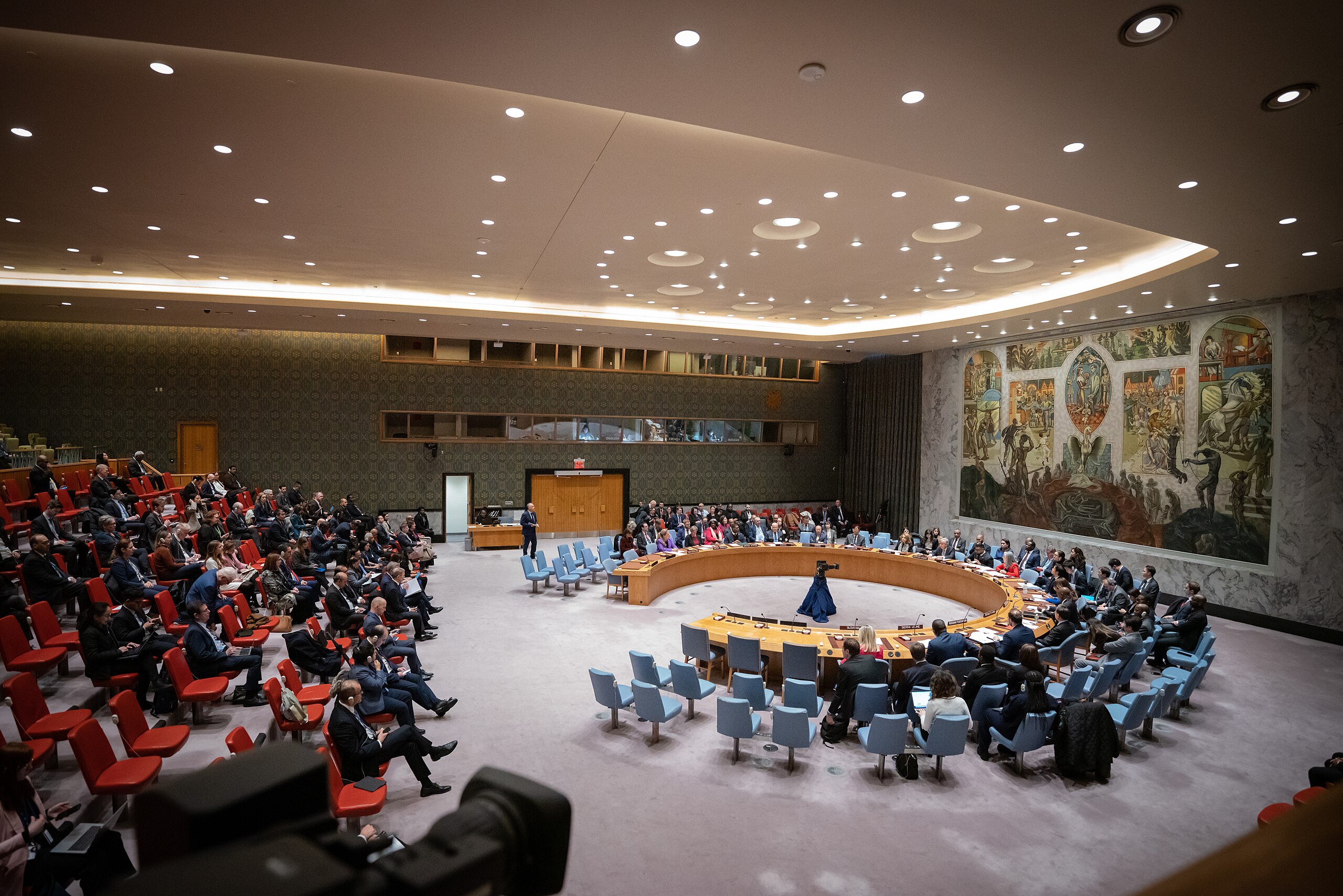

The United Nations Security Council (hereinafter: UNSC) has formally adopted Resolution 2803 (2025), authorising the establishment of a “Board of Peace” and an International Stabilisation Force (hereinafter: ISF) for the Gaza Strip. The resolution, passed on Monday, 17 November 2025, endorses the “Comprehensive Plan to End the Gaza Conflict” proposed by the United States of America’s (hereinafter: USA) government. While the USA hailed the vote as a “historic” step towards stability, the Palestinian faction Hamas rejected the initiative, characterising it as an imposition of “foreign guardianship” over the territory, whereas the Palestinian Authority (hereinafter: PA) welcomed the resolution.
UNSC Vote and International Mandate
The 15-member council adopted the resolution with 13 votes in favour and zero against. The People’s Republic of China and the Russian Federation, both permanent members with veto power, abstained from the vote, allowing the measure to pass.
According to UN News, the resolution welcomes the establishment of a “Board of Peace” which will function as a “transitional administration” in Gaza. This body is mandated to coordinate reconstruction efforts and establish the temporary ISF. The text stipulates that the ISF will deploy under a unified command acceptable to the Board of Peace and will operate in “close consultation and cooperation” with the governments of Egypt and Israel.
USA and Russian Positions
Following the vote, the US Ambassador to the UN, Mike Waltz, described the resolution as a “historic and constructive” development. He stated that the measure charts “a new course in the Middle East [Sub-Anatolia]” and creates an environment that allows Israel to live in security while enabling Gaza to prosper. Specifically, the ISF is tasked with stabilising the security environment, supporting the demilitarisation of the strip, dismantling “terrorist infrastructure” and decommissioning weapons.
Conversely, the Russian Federation expressed reservations regarding the governance structure. Russian Ambassador Vasily Nebenzya stated that by adopting the resolution, the Council was essentially “giving complete control over the Gaza Strip to the Board of Peace and the ISF,” noting that the specific modalities of these bodies remain unclear.
Hamas Rejects “Foreign Guardianship”
In response to the diplomatic developments in New York, Hamas and other armed factions in Gaza issued a firm rejection of the plan. According to Al Jazeera, the group stated that it refuses any form of “foreign guardianship” or external military intervention, viewing such measures as a violation of Palestinian sovereignty.
The factions reiterated their refusal to disarm, directly contradicting the mandate of the newly authorised ISF, which includes the decommissioning of weapons. The Al Jazeera live report noted that the groups consider the governance of Gaza to be an internal Palestinian matter and have dismissed the resolution as serving Israeli interests.
On the other hand, the PA has welcomed the resolution, committing itself to full cooperation with the foreign state and non-state actors. This marks a rift between the Palestinian factions, underlining that different visions for the remaining Palestinian territories exist.
Concluding Outlook
The adoption of Resolution 2803 establishes a formal international legal framework for the post-conflict administration of Gaza. However, the biggest challenge for the UN will be to limit the USA’s involvement. As a nation known for taking control over foreign governments, this resolution presents the ideal conditions for the USA to incrementally exert control over Gaza. By extension, Israel can exert influence over Gaza through the USA. Hamas’ negative stance towards the resolution, therefore, is quite understandable.
However, there are limited policy and solution options at this point in the war. The agreed ceasefire with Israel was in danger due to Israel’s continued aggression, and the international state community was reluctant to intervene in the war altogether. With support for Palestine limited to diplomatic gestures and aid packages, Resolution 2803 is a significant measure that could improve Palestine’s situation in the mid-term. Finally, it is important that the state community also holds Israel accountable if the agreement is breached.