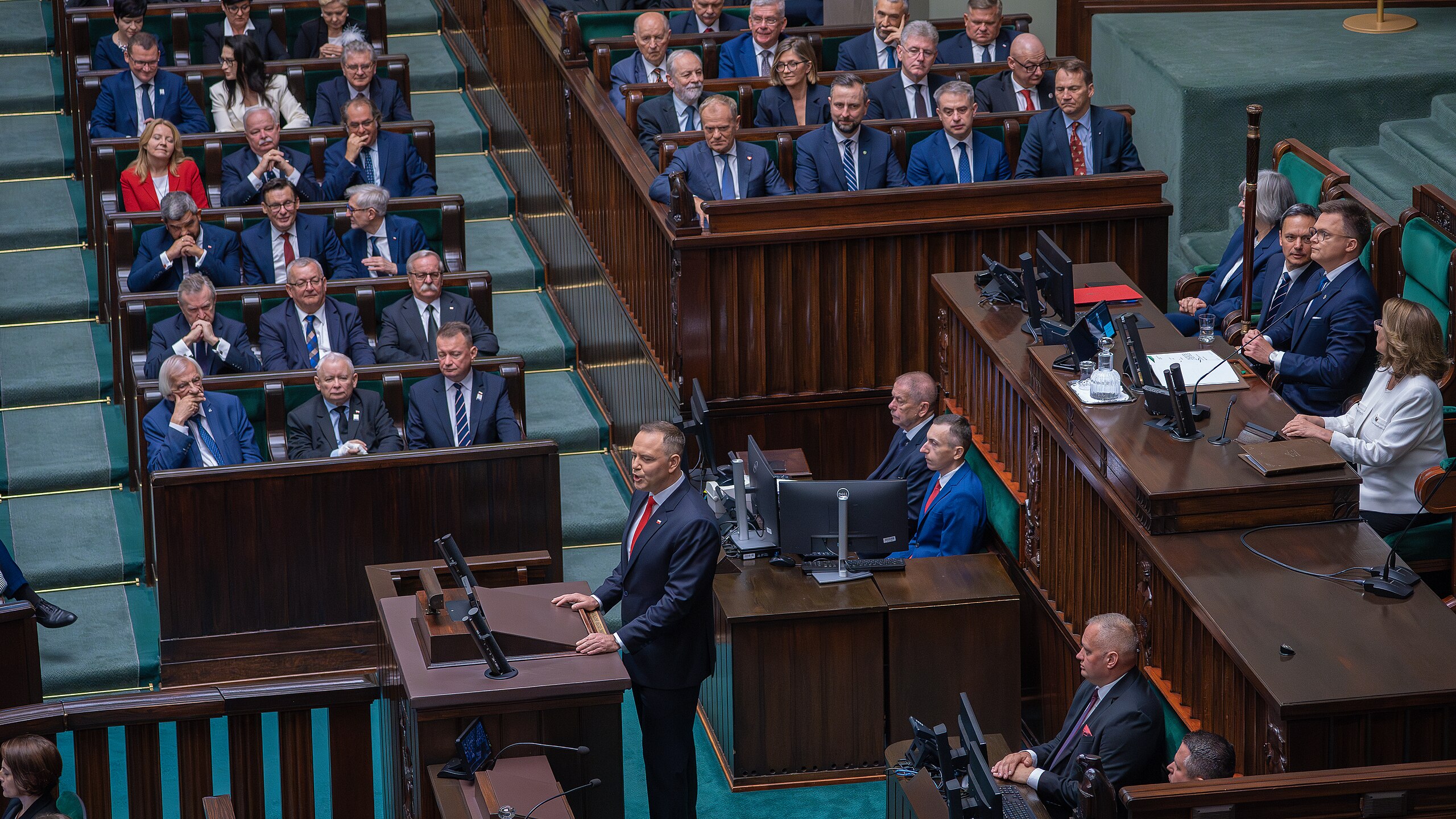

Poland entered a genuine cohabitation in the summer of 2025. Karol Nawrocki, a conservative historian and former director of the Institute of National Remembrance (hereinafter: the IPN) backed by Law and Justice (hereinafter: the PiS), won the 1 June presidential run-off by a margin of 50,89% to 49,11% against Rafał Trzaskowski, the Mayor of Warsaw and a leading Civic Platform politician who was also the opposition’s presidential candidate in 2020 and was sworn in on 6 August. His inaugural address telegraphed confrontation with Prime Minister Donald Tusk’s pro-European Union (hereinafter: the EU) government, clarifying that the presidency would be an active counter-centre of power. Institutionally, the presidency’s most consequential lever is the legislative veto under Article 122 of the Polish Constitution. A veto can be overridden only by a three-fifths majority of the Sejm in the presence of at least half of all deputies, a threshold the governing coalition does not command, so negative control over the cabinet’s programme is credible from day one.
The first fortnight confirmed that expectation. On 21 August, President Nawrocki vetoed a government bill that paired an extension of the household electricity price freeze with liberalisation of onshore wind rules, denouncing the “bundling” as legislative blackmail; ministers immediately began exploring administrative work-arounds to keep parts of the energy agenda moving. Four days later, on 25 August, he vetoed a bill extending benefits for Ukrainian refugees into 2026, a move that also threatened to interrupt Poland’s legal basis for funding Ukraine’s Starlink connectivity, Starlink being SpaceX’s satellite internet service widely used to support Ukraine’s civilian administration and battlefield communications, from 1 October unless a replacement instrument passed quickly. These early decisions set the tone and the stakes. Rather than stopping policy outright, the presidency is re-sequencing it: urgent, high-visibility relief (such as price freezes) can proceed on its own terms, while structural reforms that create concentrated local losses (such as wind-siting liberalisation) or visible redistributive winners (such as refugee support) face higher evidentiary thresholds. Because omnibus drafting ties disparate provisions together, vetoes can also generate externalities beyond the original file, most visibly where domestic welfare or budget acts carry hooks for foreign-policy delivery to Ukraine. In short, Poland’s cohabitation is not merely a constitutional curiosity; it is a bargaining regime that re-orders the government’s priorities under tight arithmetic. This article examines the first months of that bargaining, mapping the presidency’s veto strategy and its effects on energy policy, refugee-support measures and Ukraine-related financing channels and specifies the conditions under which narrowly tailored (non-omnibus) bills can still pass.
The Veto Architecture and the Bargaining Map
Poland’s cohabitation runs through a few hard-edged constitutional channels that determine who holds leverage, when and at what cost. After a bill clears both chambers, the Marshal of the Sejm, the chamber’s speaker, submits it to the President, who faces three mutually exclusive choices: (i) sign within 21 days and order promulgation; (ii) make a preventive referral to the Constitutional Tribunal (CT) before signing; or (iii) issue a suspensive veto by returning the entire act to the Sejm with reasons. Each choice carries a distinct follow-on: if the CT upholds constitutionality, the President must sign; if the CT finds only severable defects, the President may sign omitting the offending clauses or return the act for correction; if the President vetoes, the Sejm can repass the act only by a three-fifths majority (with at least half of deputies present), after which the President must sign within seven days and may not send the repassed act for preventive review. Crucially, a veto or a CT referral suspends the running of the signature deadline. These mechanics, timers, tolling and a high override bar, are the backbone of bargaining under divided executive power.
Two design features maximise presidential leverage over form as much as substance. First, Poland has no line-item veto: the presidency returns the whole act, not individual provisions. That “all-or-nothing” structure makes omnibus bundling a politically costly drafting tactic, because one controversial clause can sink an entire package. (Selective pruning is possible only via a CT judgment that identifies unconstitutional, severable clauses.) Second, the Budget Act is carved out: the President must sign a budget (or interim budget) within seven days of receipt, and Article 122(5)’s veto-override pathway does not apply, though a preventive referral to the CT remains possible and must be adjudicated swiftly. Together these rules narrow presidential influence over fiscal timing while preserving constitutional review; conversely, they raise the payoff to challenging bundled policy changes outside the budget.
Urgency rules reshape the calendar but not the votes. Under Article 123, the Council of Ministers may classify its own bill as urgent, which shortens the Senate’s consideration window and reduces the President’s signature window to seven days, yet the three-fifths override threshold is unchanged. Urgency cannot be used for sensitive categories, tax bills, election laws, statutes on the structure and jurisdiction of public authorities or law codes, so even a time-compressed docket does not extend to the most constitutionally delicate files. In practice, this means the cabinet can accelerate narrow, time-critical measures, but structural overhauls and institutional designs remain exposed to the ordinary veto game.
Mapped onto politics, the architecture converts law-making into a sequencing contest. Cabinets maximise progress by decoupling popular, short-horizon relief from divisive structural reforms; by avoiding omnibus packaging; by using urgent status where permitted; and by re-tabling trimmed texts after a veto. Presidencies maximise leverage by pairing preventive review with targeted vetoes; by punishing bundling (given the non-selective veto); and by demanding higher evidentiary standards wherever reforms create concentrated local losses or visible redistributive winners. Under cohabitation, the operative question therefore shifts from “what can we pass?” to “what cannot be stopped, on what timeline and at what price?”, a question that can be tracked in deadlines met or tolled, CT referrals, override maths (276 votes) and the observed frequency with which multi-topic bills are split into single-subject acts.
The First Two Vetoes: Signals, Not Just Events
The opening fortnight of cohabitation in Poland did not merely produce two discrete vetoes; it articulated a governing doctrine for the presidency. On 21 August 2025, President Karol Nawrocki rejected a government package that coupled an extension of the household electricity price freeze with onshore wind liberalisation. He castigated the very form of the bill, calling the bundling “blackmail” and objected to looser siting rules (a shift widely read as moving minimum distances from 700m toward 500m and further rolling back the legacy 10H constraint). That stance leaves short-horizon affordability measures negotiable on their own terms while forcing structural market rewiring onto a harder legislative track. The cabinet responded by scouting administrative routes to keep onshore wind moving without immediate primary legislation.
Four days later, on 25 August, the President vetoed the extension of core benefits for Ukrainian refugees into 2026, arguing that access should be tightened (for example, privileging employed recipients). Substantively, the move reframed redistribution as a “Poles first” priority; procedurally, it also revealed how omnibus drafting can create foreign-policy externalities. The vetoed act carried the legal-budgetary hook for Poland’s financing of Ukraine’s Starlink connectivity; ministers warned that, absent a rapid replacement instrument, support could lapse from 1 October. The Presidency counter-messaged that funding could be restored via an alternative bill, but the episode nevertheless exposed the risks of embedding external delivery lines inside domestic social legislation.
Taken together, these vetoes codify three rules of engagement. First, an anti-bundling rule: because Poland’s veto is not line-item, a single divisive clause can sink an entire act; omnibus packages, therefore, become inviting targets. Second, a sequencing rule: the presidency will sign or promote short-horizon relief when decoupled (e.g., price freezes), while imposing a higher evidentiary bar on structural changes with concentrated local losses (e.g., wind siting, market design). Third, a collateral-tolerance rule: if the cabinet ties external commitments (such as Starlink financing) to contentious domestic redistributive provisions, the presidency will still veto and force re-drafting, accepting short-term friction with partners to police form as well as substance. In other words, these were not one-off clashes; they were position-taking moves that map the bargaining terrain for the year ahead.
What to watch from here. On energy, observe whether the government’s promised regulatory workarounds can deliver near-term capacity additions while a narrower wind bill is prepared; on welfare and Ukraine support, track whether the presidency’s alternative draft reinstates Starlink funding on a separate legal basis and how quickly parliament processes it. The speed and sequencing of these follow-ups will tell us whether the veto wave disciplines legislative practice or imposes a persistent “tax” on state capacity by delaying structural investments and complicating allied support.
Veto Exposure, Spillovers and the Government’s Toolbox
Poland’s early cohabitation reveals a patterned vulnerability across three policy families, each with distinct political economies yet a shared sensitivity to presidential negative control. Targeted redistribution is the most immediately exposed. Because beneficiaries are visible and fiscal incidence is salient, these measures invite fairness and work-incentive frames that travel well in public debate. The presidency can therefore contest not only the scale and eligibility rules of transfers, but also the form in which they are legislated, penalising omnibus drafting and forcing the cabinet to defend every embedded clause. In practice, veto threats raise the evidentiary bar: ministries must document distributional effects, sunset clauses and fraud safeguards with greater precision, or else watch support instruments return for re-drafting. The result is not automatic retrenchment but sequencing: short-horizon cushions can pass when decoupled, whereas enduring entitlement changes face repeated justification.
A second exposed cluster is the green transition and market design agenda. Planning liberalisation, siting distances, grid-connection rules and support schemes create concentrated local losses alongside diffuse, longer-run gains. That asymmetry makes these files ideal terrain for veto entrepreneurship. When reforms are bundled with urgent affordability measures (for example, price caps or bill rebates), the presidency can reject the package as coercive “legislative bundling”, signalling willingness to sign the relief component while compelling the government to return with a narrower bill on permitting or market rewiring. Administratively, parts of the energy agenda can advance via secondary legislation or regulatory guidance, but the core of market design, statutory siting standards, compensation formulas and competitive support mechanisms remain statute-dependent and hence veto-exposed. In short, form matters as much as substance: the same reform framed as a single-subject act with a clear cost narrative fares better than one nested inside a heterogeneous package.
Third, EU-aligned reforms, judicial, regulatory or governance changes tethered to disbursement milestones, combine legal complexity with distributional losers. They are therefore double-vulnerable: opponents can attack the content (competences, institutional balance) and the consequences (who pays, who adapts). Under cohabitation, even procedurally narrow alignment bills can be slowed by preventive constitutional review or returned on drafting grounds, with knock-on effects for fund-release schedules. This does not imply an inevitable freeze; it means the cabinet must invest in pre-legislative consultation, public justification and clause-by-clause robustness to minimise the surface area for a full-act veto.
These domestic dynamics do not remain domestic. They spill over through two principal channels. First, Ukraine-related delivery lines are sometimes anchored in social or budget statutes, for instance, communications, logistics or procurement support administered through line-ministry appropriations. If such hooks are embedded in contentious redistributive bills, a veto can create a timing shock: legal authority lapses before a replacement instrument is enacted. Even when all actors intend continuity, the mere need to craft, file and process a clean bill introduces risk into delivery windows and invites reputational costs with partners. Second, EU funds and compliance are time-sensitive. Veto-induced re-sequencing can push milestones beyond quarter-ends or calendar windows, squeezing fiscal space for energy transition and social cushions. The fiscal squeeze then feeds back into the politics of redistribution and green reform, further raising the salience of the very files most prone to veto.
Because vetoes operate through timing, form and salience, the government’s most effective responses are design choices rather than grand bargains. Two tools matter.
- Decouple and sequence
Separate urgent affordability measures from structural rewiring. Single-subject bills reduce the political return to a full-act veto and make assent easier to justify publicly. Where coupling is unavoidable (e.g., because implementation synergies are real), include explicit severability clauses and clear, modular chapters to facilitate rapid re-tabling if an act is returned.
- Integrated implementation bundle: bridges, tailoring and procedural guarantees
Treat delivery risk as a composite problem that is best managed by combining three levers in one package:
- Administrative bridges (used carefully). Deploy executive regulations, ministerial ordinances and cabinet resolutions to unlock short-run capacity (grid connections, auction calendars, administrative guidance) where primary legislation is not strictly required. Use these as bridges, not substitutes: they buy time, test operational details and generate data to de-risk the subsequent statute. Ensure legal bases are unambiguous to avoid successful challenges that would reset the clock.
- Localised tailoring and compensation design. Where reforms create concentrated local losses (wind siting, infrastructure corridors), combine tighter buffers or opt-out zones in high-conflict counties with fast-track procedures and standardised community-benefit schemes in low-conflict areas. By lowering the perceived local cost while preserving national momentum, such tailoring shrinks the coalition for a veto and improves the optics of distributive fairness.
- Procedural pre-commitments and transparency. Publish drafting calendars, consultation windows and impact assessments; circulate exposure drafts to opposition committees and the presidential chancellery before plenary. These steps narrow the rhetorical space for “legislative blackmail” claims, reduce surprises that trigger all-or-nothing pushback and create a record that raises the political cost of blanket refusal. Where appropriate, classify genuinely time-critical bills as urgent to compress decision windows, but avoid stretching the category to files explicitly excluded by constitutional practice (e.g., election law, tax codes), which would invite procedural contestation.
The pay-off from this toolbox is cumulative rather than spectacular. Decoupling yields smaller, cleaner acts that are easier to defend and, if vetoed, faster to re-table. Administrative bridges keep delivery moving and generate evidence. Tailored carve-outs convert national stalemates into manageable local compromises. Procedural guarantees shift the public narrative from confrontation to due process. None of these eliminates conflict; together, they reduce the probability and expected cost of a veto and shorten recovery times when one occurs.
Conceptually, the merged picture is coherent. Veto exposure is greatest where winners and losers are legible; spillovers arise when those files carry external hooks; and state capacity is preserved when the cabinet treats form as a policy instrument, sequencing relief and reform, modularising legislation and building procedural trust. Under cohabitation, success is measured not by the absence of vetoes but by the tempo of policy: how often complex bills return slimmer and stronger, how quickly bridging measures prevent delivery gaps and how reliably external commitments survive domestic shocks.
Scenarios for 2025-2026 and What to Watch
Cohabitation in Poland is best conceived as a sequencing game in which actors reorder the government’s agenda in time rather than halt it outright. Over the next 12-18 months, the evolution of this game can be read through three stylised pathways that are analytically distinct yet may co-exist across sectors and over time. In a narrow-corridor compromise, the cabinet internalises the presidency’s anti-bundling signal and advances single-subject bills while relying on administrative “bridges” to maintain delivery on price relief and grid connections as slimmer structural texts are prepared. Progress is real but uneven: administrative load rises and market-design reforms advance in fits and starts. In an iterated deadlock, vetoes and preventive constitutional referrals spill beyond welfare and energy into EU-linked alignment files; override arithmetic remains out of reach, and quarter-end milestones for EU disbursements slip, producing investment uncertainty and a tightening fiscal envelope. A third path, issue-specific bargains, trades geographically tailored carve-outs, stricter buffers or opt-out zones in high-conflict counties, for statutory progress elsewhere; the result is a patchwork of pilots and region-coded clauses that cumulatively move the agenda without a grand bargain.
To adjudicate among these pathways, analysis should rely on a compact, operational indicator set rather than interpretive rhetoric. First, a veto timeline and override arithmetic records the date, reasoned objections, and Sejm vote counts against the three-fifths threshold, noting any use of the “urgent” classification. A rising share of repassed acts on first re-tabling and a decline in preventive referrals are consistent with narrow-corridor dynamics; clustering of vetoes and referrals on alignment statutes, combined with repeated failures to reach 276 votes, signals deadlock; a lower overall veto rate alongside an uptick in region-coded clauses points to issue-specific bargains. Second, implementation delays, the median and 90th-percentile days from cabinet approval to operationalisation for (i) price relief, (ii) grid/connection measures and (iii) planning approvals, separate delivery from drama: stable or shortening medians in (i)–(ii) with volatility in (iii) fit the compromise scenario; widening delays across all three baskets indicate drift towards deadlock; divergent county-level speeds (fast in low-conflict zones, slow in hotspots) suggest issue-specific bargaining. Third, a distributional map overlays the onshore wind project pipeline (applications, permits, MW) with the density of transfer beneficiaries, annotated by presidential visits and parliamentary dissent; broad stalling and flashpoints around beneficiary clusters are characteristic of deadlock, while selective advances tracking carve-outs identify the bargaining path. Fourth, an externality tracker follows continuity in Ukraine-related delivery lines and EU-fund milestones, logging the use of bridge instruments (interim legal bases, supplementary appropriations) after vetoes; on-time delivery with occasional bridging is compatible with compromise, recurrent last-minute gaps with formal Commission correspondence indicate deadlock and stable national delivery with uneven local timing aligns with bargains.
For empirical discipline, thresholds should be specified ex ante as heuristics rather than mechanical rules. For example: a single-subject share of welfare/energy acts at or above ~70% over two consecutive quarters would evidence form discipline consistent with compromise; a Constitutional Tribunal referral rate on alignment files above ~40% in a quarter or repeated referrals on the same file, would indicate drift towards deadlock; a >30% quarter-on-quarter rise in the median planning-approval delay together with a >50% rise in the 90th percentile would flag delivery stress; and the appearance of region-coded clauses in at least half of structural bills filed in a quarter, alongside the launch of several low-conflict pilots, would signal consolidation of issue-specific bargains. These thresholds are deliberately conservative: they create a common language for researchers and practitioners to read the same dashboard.
The interpretive pay-off is twofold. Substantively, the framework clarifies how veto power converts visible winners and localised losses into agenda-setting leverage and how domestic sequencing generates external spillovers through Ukraine support channels and EU funding calendars. Methodologically, it anchors claims about “blockade” or “compromise” in observable sequences, votes, deadlines, referrals, regional clauses and measured delays, rather than in partisan narratives. In cohabitation, success should be measured less by the absence of vetoes than by the tempo and continuity of delivery under veto: how often complex bills return slimmer and stronger, how reliably bridge instruments prevent gaps and how consistently external commitments survive domestic shocks.