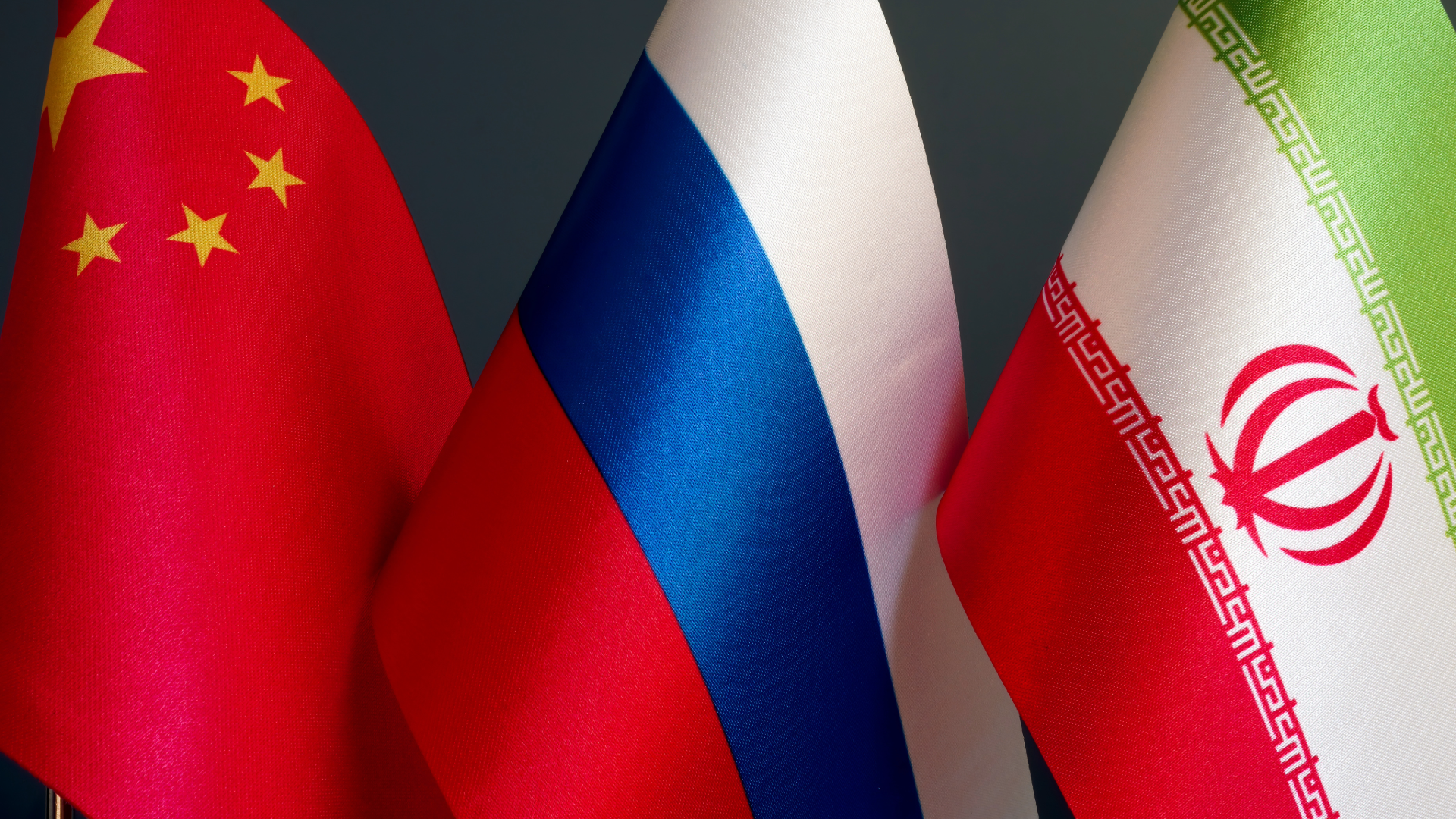

The most recent developments between the Islamic Republic of Iran (hereinafter: Iran) and the State of Israel, opposing each other in a territorial war, are the next step in their escalating geopolitical situation. While the primary root causes of this conflict have been addressed in several of our analyses (e.g., Israel and Iran: Behind Political Narratives), this article focuses on the Iranian leverage points in this recent war, as well as the potential involvement of its geopolitical partners. These new military escalations, particularly due to the initiation of the closest partner of the Israeli state, namely the United States of America (hereinafter: USA), increase concerns about an expansion of this conflict. Due to the strong interconnections and dependencies between the USA and the State of Israel, the geopolitical ambitions of both states in this region are largely aligned, perhaps with slight differences in concrete goals. Additional partners, especially states within the European Union (hereinafter: EU), are currently debating whether and how to support this war against Iran, for example, by providing military infrastructure and resources. In contrast, it remains relatively silent around the traditional partners of Iran, namely the Russian Federation and the People’s Republic of China. Despite verbal accusations and an urgent call to stop the military actions against Iran, there has not been significant participation by the two nations yet.
This analysis highlights two interconnected aspects. First, it examines Iran’s leverage points in the conflict, both material and narrative. Second, it shifts focus to Iran’s international partners, offering an interpretation of the conflict through their perspectives. These dimensions are closely linked, as both the Russian and Chinese positions are likely to depend on the course of the conflict and Iran’s strategic use of its leverage. Before addressing these core analytical components, the paper provides a brief overview of Iran’s broader geopolitical position and its attractiveness as a strategic partner.
Iran As An Important Partner: Resources, Geographics And Geopolitical Interests
Beginning with its resources, Iran holds the world’s fourth-largest oil reserves and the second-largest natural gas reserves. Especially China, whose economy heavily relies on cheap energy, is the main importer of Iranian oil, accounting for 13,4% of its total demand in 2025 (Reuters). Furthermore, through several sanctions on Iran, primarily led by the USA, the state developed a complex infrastructure to circumvent (Neo-)European-controlled financial networks and maritime trade routes. This allows China to import oil independently of sanction restrictions. In addition to its rich energy resources, Iran also plays an important role in global mineral supply, as it holds significant deposits of copper, iron ore, zinc, lead and coal. Besides their great resource capacity, the geographical situation further favours the Persian nation as an essential partner. For example, is Iran’s ability to avoid European and Neo-European sanctions tied to its geographic role as an important pillar in the International North-South Transport Corridor (hereinafter: INSTC), providing direct access to the Indian Ocean for Russia or Central-Asian states. By directly controlling the Strait of Hormuz, a vital trade route for about 20% of global oil shipments, Iran (and its partners) can potentially exert significant pressure on the global economy. Furthermore, Iran also offers a land-based bridge connecting East Asia to Sub-Anatolia and Europe, bypassing foreign-controlled waters, which plays a significant role in the Chinese Belt and Road Initiative. The importance of this land-based bridge, also known as the Middle Corridor, is not merely tied to avoiding maritime trade routes, but also to allowing China to diversify its land trade routes away from its traditional Northern Corridor through Russia. This aspect gained increasing significance since the beginning of the Russian-Ukrainian war. Given this geographical position, which provides economic leverage comparable to that of the Strait of Hormuz, China has a considerable interest in the stability of the diplomatic relationship between Tehran and Beijing.
Similarly, Russia is equally interested in stable diplomatic relations with the Persian state. The geopolitical aspects are therefore deeply tied to the resources Iran has inherent and its geographic situation, but maintaining mere access to the benefits does not fully grasp this dimension. Israel’s Arab neighbours have undergone systematic destabilisation through political fragmentation or direct military intervention, frequently led by the USA. In particular, Iraq and Syria have been exhausted by decades of territorial warfare, intense sanctions and civil strife. These nations currently struggle to establish resilient political systems; specifically, the process of sovereign state-building – one that is organically rooted in society rather than externally installed – remains a long-term challenge that will require extensive reconstruction. The Persian nation, on the other hand, due to a distinct socio-cultural and historical evolution that differs from its Arab neighbours, has a high degree of national cohesion and a centralised state identity. This, combined with a rugged topography that naturally complicates external invasion, increases the state’s resilience to foreign threats. Thereby, Iran constitutes the last hegemonic opponent to Israel; the last factor that hinders complete dominance and control by the USA and Israel over Sub-Anatolia. For Russia and China, a strong and independent Iran is a strategic necessity to offset the accumulation of power by the USA and decrease their influence in the region.
War For Hegemonic Power Implementation: Why Do Russia And China Not React?
Obviously, this war, like all ideological and expansionary wars, is fought to further implement the power architecture of the dominant actor. The USA and Israel have no incentive for a peaceful coexistence with the Persian state if they view themselves as overwhelmingly powerful (high power discrepancy), as there is no reason to find compromises. This standing is observable since the Islamic Revolution in 1979, but has been highlighted in recent developments, e.g., 2025, when Israel attacked Iran moments before an agreement in negotiations about nuclear infrastructure. The USA perceives the need for a pro-Washington government, similar to the Shah regime before the Islamic Revolution, in order to gain control over the above mentioned economic and strategic leverage, while Israel needs to inherit a monopolistic position for their military and religious expansionism. Here, it is immaterial whether the disruption of the status quo is achieved through a comprehensive political system change or through the complete erosion of Iran’s instruments of sovereignty and power. But if the Iranian regime is such an important pillar for the Russian and Chinese geopolitical landscape, why do they not react to the imminent threat Iran is facing right now?
Iranian Situation
Examining the situation through an Iranian lens, the threat is not as imminent as it seems at first glance. Certainly, this war is, and will be comprehensive, as it is the climax of a circle of escalation, and, especially through the killing of the religious leader of Shia muslims Ali Hosseini Khamenei, reached a point of intensified normative involvement of the Iranian people. Furthermore, the Iranian government has concluded that negotiations and any form of compromise are not achievable under the current circumstances; therefore, a limited exchange of isolated or wave-like military strikes, as observed last summer, is unlikely. Instead, the conflict is expected to escalate into a more comprehensive and sustained confrontation. However, there are several aspects that suggest that this threat is not as imminent as it may initially appear. First of all, Jiang Xueqin, a professor of predictive history who gained media attention for his USA-Iran predictions, notes that Iran has several advantageous leverage points in this war, while the USA’s military advantages are merely “hypothetical”. The perceived technological advantages that the USA and its partner Israel have are, compared to the high economic costs that come along with them, virtually non-existent. Several media reports highlight the significant discrepancy between the costs of Iranian drones on the one hand and the technology to counter them on the other (e.g., New York Times). Therefore, the obtained results on invested capital in the aggression against Iran are negative and create an increasing disadvantage as the war is prolonged.
Another leverage is the already mentioned Strait of Hormuz, which has been closed by Iran since the first day of the war. While in previous conflicts, European and Neo-European-led convoys could protect oil tankers that pass the strait despite Iranian threats, the use of cheap drones to threaten these convoys changes this very dynamic. Furthermore, attacks on the Gulf states also carry significant leverage in this war, as their economies depend on oil (exports) and water (reservoirs), both of which are easily targetable with intermediate-range missiles. Thereby, Iran could force the Gulf states to negotiate, for example, to block the usage of military infrastructure for the USA. Should aerial bombardment and missile warfare fail to achieve the desired outcomes, the USA do not rule out a ground offensive against Iran. In fact, according to various media reports, this strategy may already be in its incipient stages, with the deployment of independent Kurdish terror groups into Iranian territory to destabilise the border regions. A ground war on Iranian territory is an immensely complex and risky operation due to its formidable terrain and therefore serves as a leverage as well.
Besides material or physical components, Iran also possesses the chance to conquer narrative leverage. As the very intentions for the attacks are the implementation of greater power discrepancy, any European and Neo-European narrative of an Iranian threat appears hypocritical (despite any evaluation of the domestic situation), allowing Iran to steadily build a web of global assistance in the form of rhetorical or material support (e.g., Spanish Prime Minister Pedro Sánchez). One must also not underestimate the religious aspect. Michael Lüders, a German political scientist and Islamic studies scholar, underlines the importance of the killing of Khamenei as martyrdom, potentially unleashing a backlash whose impacts are not yet feasible. This will, contrary to the idea of the USA, not lead to a wave of domestic revolt to overthrow the Muslim government, but rather the opposite: further consolidating the nation’s sense of sovereign identity against external interference. Additionally, this could trigger a surge of transnational Shia solidarity, as we have already witnessed in India. How this is going to affect the political stance with Sunni Muslims Arab nations, for example, the Gulf states, will be an important factor in this conflict.
Russian Perspective
Based on the points highlighted in this article, it is clear that Russia has a strong interest in Iran’s success in defending its sovereignty militarily. As Iran is fighting a defensive war, with an ultimate goal of remaining the status quo, the success needs to be defined as preservation of Iran’s territorial integrity and the survival of its sovereign political structure. The current attacks do not existentially threaten Iran’s sovereignty and therefore do not indicate a loss that would force its partners to react more comprehensively. But on the other hand, one could argue that the uninterrupted possibility of the USA and its allies attacking a very important geopolitical partner reveals some truths about the structural deficits Russia has. Geopolitical power is frequently described through Max Weber’s definition: “The probability that one actor within a social relationship will be in a position to carry out his own will despite resistance.” This definition inherently associates power with a relational and relative nature and therefore focuses on Russia’s inability to react or to hinder international power plays by the North American nation. The counterargument here is that Russia (and China) intentionally withholds full-scale support to bait the USA into a protracted war that would drain their resources and destroy a still-existing narrative of military supremacy. Much like the Vietnam War, that “bleeding-out” strategy would not only damage the economic strength of the USA but also shatter the myth of its military invincibility.
Analysing Russia’s general geopolitical situation, it is evident that the nation is constrained by its strategic overextension and limited capacity to project power on multiple fronts simultaneously. By examining the continuous decrease of Russia’s activities and influential presence in Central-Asian states, it becomes questionable if withholding support for Iran is a tactical bait, but rather a pragmatic necessity. The perceived importance of Central-Asia for Russia is rooted, among others, in a century of shared Soviet history, which created a radial infrastructure oriented towards Moscow and cemented the region’s function as a strategic buffer zone for Russian national security. Consequently, a close economic and security-related relationship exists among the former Soviet republics, institutionalised through frameworks such as the Collective Security Treaty Organisation (hereinafter: CSTO). However, a steady decline in Russian influence is observable as both China and European and Neo-European nations secure their own strategic and potentially exploitative advantages in Central Asia. They achieve this through economic platforms, such as the USA-led C5+1 summit and its European counterpart, the Z5+1, and through their pivotal roles in the Middle Corridor. Moreover, European and Neo-European secondary sanctions targeting Russia, which increasingly impact Central Asian financial institutions, have rendered close ties with Moscow progressively less attractive. Here, Russia also has no capacity to successfully stop this trend; its traditional regional hegemony steadily decreases, as its diplomatic and military resources are overstretched. Accordingly, it is questionable which material support Russia can provide when it is unable to uphold one of its most vital strategic pillars.
Chinese Perspective
In contrast to Russia, whose restraint appears to be largely shaped by structural constraints, the Chinese approach towards the war reflects a different strategic logic. Beijing’s withholding of active military support should therefore not be interpreted as a sign of incapacity, but rather as an expression of calculated pragmatism embedded within the broader framework of Chinese foreign policy. One important aspect in this regard is the long-standing framework of non-interference, which continues to serve as a fundamental pillar of China’s foreign identity. By avoiding direct military involvement, China is able to preserve its self-portrait as a comparatively neutral state, in contrast to the expansionist orientation of the USA. Maintaining this image enables China to uphold functional diplomatic channels not only with Iran, but also with several of its regional counterparts, including the Gulf states of Saudi Arabia and the United Arab Emirates, thereby protecting its broader economic and geopolitical interests despite the potential development this conflict may take. This restraint thus also serves an important narrative function, as by positioning itself as a power that refrains from direct military escalation while continuing to emphasise diplomatic and economic cooperation with both sides, China strengthens its attempt to present an alternative model of international leadership.
In this narrative framework, Iran is not necessarily a partner that must be defended at all costs, but rather one element within a broader geopolitical environment in which China aims to gradually reshape the structures of global influence. At the same time, China’s extensive economic diversification further reduces the structural necessity for immediate intervention. Although Iran constitutes an important energy partner, China has deliberately expanded its economic relations across a wide range of regions within the Global South, thereby limiting its dependence on any single supplier. This diversification provides China with a form of strategic dominance, allowing it to observe the escalation without facing an immediate threat to its domestic energy security. In addition to these economic aspects, China also possesses significant capacities that could theoretically be mobilised in support of Iran. However, the deployment of these resources would divert attention and assets from what China considers its core strategic theatre: the question of Taiwan. From this perspective, premature involvement in Sub-Anatolia could potentially weaken China’s long-term strategic priorities. Accordingly, through this global lens, this broader conflict may even produce indirect advantages for China, as a prolonged military engagement between the USA and Iran has the above mentioned potential to absorb considerable military and financial resources of the North American nation. Thereby, it could reduce Washington’s ability to concentrate its strategic focus on East Asia. Finally, in relative terms, such a redistribution of attention may accelerate the gradual shift in the global balance of power that China seeks to promote.
What Should We Focus On?
Due to the volatile nature of territorial wars, the first major aspect our attention must focus on is the concrete goal-setting of the USA and its partner Israel. According to the latest media reports, the partners are in disagreement on a long-term strategy for the lasting conflict. Therefore, rhetorical and military development is crucial when evaluating potential outcomes. While the ultimate goal for Israel is to achieve a regional hegemonic position, the USA primarily wants to weaken the geopolitical partners of their imminent perceived threats, China and, though not as comprehensively, also Russia. But the actual trend in this war reveals that the USA potentially underestimated the military counter-reaction of Iran, as well as the discrepancy in costs both sides have to bear. Therefore, a potential strategy the USA could take is to proclaim a win in this war; an accomplishment in their goals, by killing political and religious leaders, as well as by harming the military infrastructure of Iran. The longer this conflict lasts, the more resources the USA and Israel will tie up in it, without a significant victory over Iran, ultimately benefiting China’s and Russia’s geopolitical leverage in all dimensions. Here, it must be highlighted that China will be the most profitable actor.
In another scenario, in which the USA and Israel start a comprehensive ground attack, China and Russia will support Iran with military resources. In this scenario, China and Russia would likely provide measured military aid, enough to forestall an Iranian defeat and sustain a ‘bleeding-out’ of North American and Israeli resources, but without committing to a decisive victory that would end the conflict prematurely. Here, the focus must be on what costs the aggressors are willing to take to accomplish their goals. It is necessary to highlight that Israel cannot win any military conflict with Iran without the support of the USA. Therefore, the intensity of false-flag attacks, as well as blackmailing strategies by the Israeli government, must be observed and evaluated during the conflict.
Finally, the last aspect that I would emphasise as crucial is the emotional resonance and mobilisation potential within the Shia Muslim community. A central pillar of their ideology is the resistance against perceived oppression by a superior force. In this context, the potential martyrdom of the leadership, symbolised by Khomeini’s legacy, could ignite a significant transnational dynamic, transforming a regional war into a broader ideological struggle.