
In our times, philosophy is experiencing a crisis. Formerly the art of thinking and reasoning, it has been degraded to an act of unrefracted verbal interchange of lower middle-class topics. Rejected and belittled by the world of science, philosophical findings have a hard time entering popular discourse. It is important to remember that the art of thinking is what provides scientific conduct with its direction. While philosophy is often unsuitable for producing hard evidence, the hypotheses born out of the act of creating chains of logic help scientists find new approaches or often even ideas for further research. Embarking on certain discussions is often enough to explore new paths of thinking that eventually lead to the resolution of sometimes age-old questions. On normative matters, philosophy can even make authoritative claims and defend them. Through abstractions and derivations, we can even use those claims to formulate rules for other areas of life. This essay is a discussion of the concept of time. Neither will be tried to define time nor to claim any finding in the field of astronomy. Rather, it aims to explore some thoughts that arise from the questions on this concept. From here, these potential ways of thinking are put into the political context and the potential implications of the streams of thought are discussed. Again, the path to the truth is rocky and not every discussion must necessarily produce a final answer. Some works are meant to be tiny steps on a long path towards the truth. This one here may be one of them.
What is Time?
Yesterday. Tomorrow. Now. How would anyone define those words? We treat time as a given. A natural law that prescribes that our life is in irreversible motion. The sequence of our actions is tied to one another so that past actions define our lives today and in the future. Once completed, however, it cannot be undone. We often act in accordance with our imagination of the future. How realistic is this imagination? It is partly informed by our experiences, our past actions. But seldom does the future turn out to unfold in the exact same way we often think about it. Is the future then not a purely imaginary concept – even if informed to some degree by currently available information? Nex to the difficulty of grasping the past and future, the most challenging concept is the present. How long lasts the present? In the act of writing, is it the moment of thinking of the next word the present or the moment of writing it down? One could also argue that the present is a longer time window, namely a period of a hermetically isolated but in itself coherent action. That could be a sentence, a paragraph, this whole essay or the whole day if writing this essay was to be the sole meaningful action of that day.
In the astrophysical debate, there are two conflicting ontological views – as we have in all other scientific disciplines. On the one side, time is viewed as something absolute and universally applicable as it is considered to be a fixed parameter. The contrasting view claims that time is relative as it is intertwined with a second concept: space. The resulting construct of spacetime is then not only relational and interconnected but also dynamic. Through the interaction with gravitation, time is then subject to a certain dynamic that conflicts with the static view of the absolute ontological approach. What both sides widely agree on, however, is that time is to be placed in the fourth dimension. As such, it is only natural that we have trouble grasping this concept as our cognitive abilities are limited to the perception of the three spatial dimensions. Therefore, the hypothetical claim of time being located at the fourth dimension, too, is subject to unclarity.
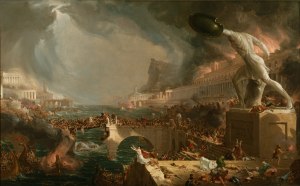
Approaching the question of time from a philosophical standpoint can produce a variety of potential topics as the unclarity around this concept is so vast. One very thrilling exercise is to think of many other perceivable phenomena in the universe and put time into the context of those phenomena. Into the smallest detail, the universe is structured around the concept of balance. To every existing object or element, there is a counteracting object or element that creates a certain balance. Sometimes, two identical objects balance each other out with countermovements. This becomes especially clear when we recognise how everything is structured in waves. Light, sound, warmth, frequencies, the seasons, the movement of planets and solar systems and even our lives are structured in waves. Even the movement of electrons in atoms can be mathematically explained with wave functions. In societal terms, civilisations rise and fall, rise again and fall again. Political systems and ideas occur and vanish. Economies flourish and fall into crisis. Wars are chased by peace. Everything has its counterweight and they interact with each other in waveform. We might not be able to account for everything in perfect detail, which is owed to our still limited analytical methods, and the declining importance of philosophy in science, but the overarching wave structure cannot be overlooked or rejected. But what about time? Here, philosophy starts.
Time seems to have no apparent counterweight. Time also does not seem to move or operate in waves. According to the relativist view, time is interacting with gravitational waves but the nature of time itself cannot be said to be in a waveform. But as we are experiencing time as a universal given, we know that it moves in one direction. It is irreversible and one-directional. Since we are currently unable to define its inherent structure and, thus, to identify a wave-like form, we must assume, for now, that time is a superordinate vectorial phenomenon. As such, we are confronted with a huge problem. If time has only one direction and now apparent counterweight, it breaks the most fundamental law of the universe, namely that everything comes in waves and is in balance. From here, philosophy can derive three hypotheses.
Hypothesis 1: There are no Laws on Waves and Balance
In this stream of thought, we would have to depart from the thinking that everything comes in waves and/or is balanced out. It would mean that this is simply not true and rather a common observation than an outright law of the universe. If time can exist without a counterweight and does not require to adopt the shape of a wave, other elements of this universe can do so, too. This would enable us to look out for more such unique elements that break the pattern of waves and balance. Especially, we would then try to understand other dimensions better, in order to find such elements. Maybe, the invalidity of the wave/balance account also points to a hierarchy of laws in the universe. In that case, waves and balance would still be laws but subordinated to other higher-ranking laws of the universe.
Applied to politics, such a hypothesis implies that nations, ethnicities and civilisations do not necessarily need to follow patterns of waves. The societal life cycles are then rather be viewed as phenomena that occurred in the context of a common correlation but are not inherently bound to this pattern of motion. In other words, civilisations do not need to experience excessive hard times in response to prolonged phases of progress. It might still happen, due to other relevant dynamics but the outright necessity would not be given in such a situation. It would imply that politics and related fields would have the chance to seek ways to achieve lasting progress and restructure societal conduct in ways that we could have not previously thought of.
Hypothesis 2: Time is an Exception
Here, time is treated as a unique phenomenon with a specially reserved place in the structured order of the universe. While everything else is regulated by the known and unknown laws of the universe, time is not subject to the laws of waves and can move irreversibly in its set direction. Such a view would practically overthrow much of what we know today or at least force us to question everything. If time is really an exception to the rule, how can we be sure that there are no other exceptions? Can we then even derive laws from our observations? We would need to question everything and look out for more exceptions. We would then need to redefine rules and put them into the context of the exceptions. This, too, would imply a certain hierarchy of concepts that would make authoritative findings in this realm even more difficult.
Applied to politics, such a hypothesis implies that we would also need to rethink the most fundamental assumptions of our being. In political philosophy, state theories are built on the definition of rules of our being. The social and biological dynamics of human beings naturally affected the system we have built and those we want to build. If there is such thing as exceptions or irregularities in the universe, we must assume that those are also present at the lower levels of existence and not just at the planetary level. How much validity would intra-societal norms and rules still have if we are to find out that the universe might even be a completely arbitrary phenomenon? Would we be still functional or driven into anarchy, knowing that the universe is not a perfectly designed and balanced system but one that is arbitrary? The implications for politics would be far-reaching.
Hypothesis 3: Time is Subject to Larger Timeframes
As we know, but often like to forget, different elements of our universe have different time horizons. The birth and death of planets differ, just as the birth and death of solar systems do. A star has a different life span than a small planet. A turtle has a different lifespan than a frog. And civilisations live longer than people. The claim of the law on waves and balance might also apply to the concept of time but in very different dimensions of time. It could be that the overarching life cycle of time is so large that we cannot but perceive it as a one-directional vectorial phenomenon. Such a hypothesis implies that time does move in waves or in an overarching circle that takes billions of years to complete. At some point then, time is repeating itself which would falsify our current understanding that time is irreversible. Contrary to the hypotheses above, this hypothesis would strongly support the notion of a balanced and rule-based universe that is moving in the form of waves.
Applied to politics, this hypothesis clearly points to the importance of attentiveness towards matters of life cycles. If we assume that this hypothesis is true, we will need to direct greater efforts towards the localisation of politics along the waves of our societal development and shape courses of policy actions accordingly. In other words, politics would seek to create countermeasures to societal decline more effectively since we would have an awareness of our position on the downward-sloping curve of the civilisational life cycle. Similarly, we would apply preserving measures more effectively on top of the developmental curve. Such an awareness would lead us to flatten out the waves of societal development, reducing downside risk and creating slow and steady growth.
Final Thoughts
All of the above, are very limited and brief insights into the endless depth of this topic. Nonetheless, it has been shown that philosophy bears the potential to stimulate such a discussion. It is not bound to have rigid views and perceptions of the world. It can be fluid and adapt different standpoints to find new ways of thinking. In this example, the hypotheses are unlikely to be verified or falsified during our time. However, they can be tiny steps on this very long road to finding the truth about time. This is a journey that we should put more effort into. Whatever the truth about time eventually is, it will change a lot.