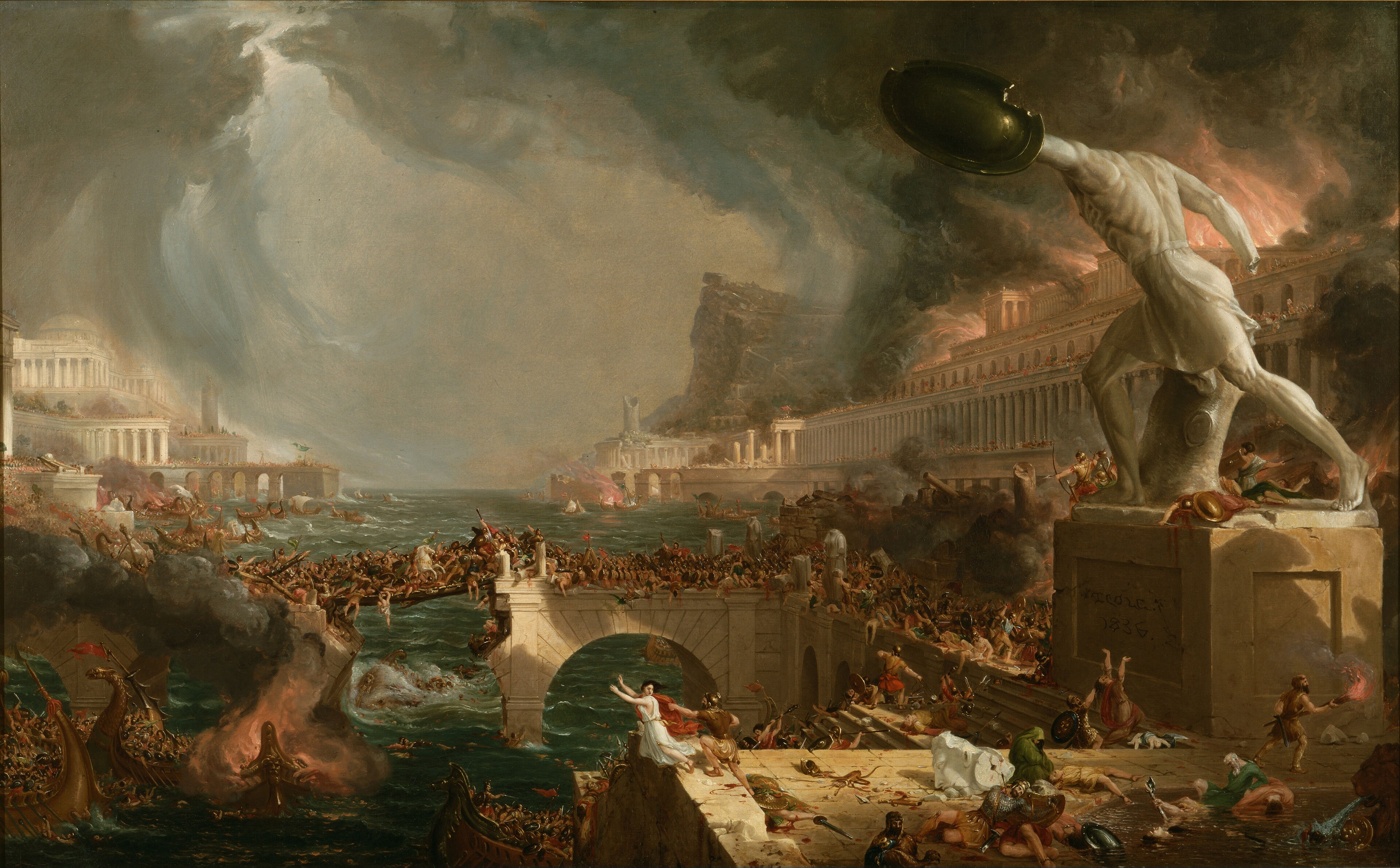

Political scientists, historians and also laymen interested in these fields have been puzzled as to why so many great civilisations rose to glory but also vanished just as often. When we look at the past years of our own times, whenever this might have been, we found history to be quite linear, or, at least, straightforward and logical. However, the farther we look back, the more questions arise. How come that great empires and civilisations that were technically so advanced ceased to be, and humanity needed centuries or even millennia just to catch up? What makes human organisation so fragile? We can apply this question to more than just societies and states. Companies, families, sports clubs, religions and friends’ groups are all equally fragile. Many extremely rich companies failed, healthy families fell apart and many more examples of failed human organisations can be found throughout history, but also on an everyday basis. It appears only logical that a strong entity, such as an empire or a multinational corporation with a perfect financial sheet, is going to use its power to solidify its position and develop further, but there are endless examples where this was not the case.
Surely, there are many, often individual, factors that lead to the demise of a specific human organisation. Especially the dynamic of marginal diminishing returns holds true for every human organisation: The bigger, stronger and more advanced it becomes, the more expensive it is for the entity to grow further, and at some point, the invested energy in growth becomes disproportional. This leads to the second factor: Everything that is not growing is dying. Connected to that is one of the most infrastructural factors that influences why marginal diminishing returns exist in the first place: relative goals. As we tie growth, success and purpose to relative goals, such as material and/or power, our actions are, in essence, not directed at some higher goal but towards increasing the relative distance to other humans in terms of material or power. The diminishing returns, thus, only indicate when people become too lazy to invest more energy into something, because it simply does not improve their social standing anymore in a significant way. Regardless of whether we talk about a state, family or a football club, if the goal is to be better than the others, then we will encounter marginal diminishing returns, as we become more successful. Further, this puts humanity in an implicit mode of negative competition and triggers an identity problem, as the underlying motivation is always directed against other humans, but is also dependent on their existence.
We all know these factors, and they are certainly of immense structural value compared to the specifics of every historical event in which a human organisation went into decline. In this work, we add another component to the understanding of why collectives of humans are so fragile, even when being greatly successful. In simple terms, one of the main reasons for the fall of empires, the demise of glorious families and marriages and the failure of massive corporations is that people leave their designated place. It is the mismatch of what a person within any human organisation is for and what this individual believes she is. Usually, at the peak of a human organisation, people start to leave their place of maximum efficiency, and effectively, that is based on their abilities, to assume a different position that they perceive to be more valuable, without having the qualities to fill this different place or role.
How Do Human Organisations Become Successful?
To understand this dynamic, we need to begin with how human organisations have become successful in the past and continue to do so. Every successful collection of people under a certain motto fulfils the following criteria:
- A common goal
- Dedication of core members to this goal based on a deep conviction
- Fixed core rules that are honoured
- Fixed roles that are honoured
The validity of these four elements also remains with relative or even detrimental goals. By outlining them, we do not make a statement about the normative quality of the group. If, for example, a terrorist organisation incorporates these four elements into its structure, maintains it and adapts supporting structures and procedures with time to uphold these four core elements, it will be successful. Every successful human organisation has been keen on preserving the health of these four elements. A common goal is important to generate the amplification effect of collective action. If individuals of a group of people all do unrelated things, there will be no progress, but also nothing to measure progress against; the common goal provides the framework. The dedication of a group’s members is the most difficult, but also the easiest part, simultaneously. To find people that are tied to the common goal in an unbreakable way is very difficult, but once found, they will generally always be there, attract similar members on their own and carry the tradition of the organisation further. Next, fixed core rules can be family norms, a society’s culture or a religious manifestation. As time goes by, application of the rules and some peripheral rules might change over time in response to a changing environment, but the core remains the same. But even if the rules change, an organisation can survive. It then often either changes its goal (or the goal changed before) or its structure.
While the factors above are directed towards the effectiveness of an organisation, the final factor is rather playing into the efficiency of the collective. Every successful human organisation has designated roles that reduce transaction costs and ensure that every member is creating maximum value within the organisation in accordance with their abilities. This can also be seen as the executive factor of the factors above. A goal and a set of rules need people who execute actions for the organisation to grow and become successful. If the members do not fulfil their roles, there is no movement towards a goal.
Why Do Human Organisations Fail?
Structural Fragility
From the above, it becomes clear that among the four equally important factors, the fourth is fragile by nature. The goal, the core members’ dedication and the rules are quite stable. It does not mean that they cannot change, but the likelihood is lower. For one, because they are fewer in numbers; there is only one goal, a handful of dedicated members and a comprehensible number of rules. But when it comes to the members and their roles, there are many. Ensuring that every member fulfils its role constantly and at the highest possible efficiency and effectiveness rate is difficult. Second, there are spillover effects. Sure, one person who is not in place cannot bring down a system, but this person can affect more people. What we can see here is that there is also a problem that game theory also picks up: One person acts in their own interest, creating incentives for others to do so, too. Depending on the size of the organisation, this is dangerous. Within a large nation, this is not a considerable problem at first, but it could end a marriage immediately. These points underline why the factor of honouring fixed roles is so fragile.
Social Distance Within Relative Goal Settings
Fragility does not directly imply decline or disruption; it just increases the likelihood of imbalance. There are many empires that were able to survive for many centuries before vanishing. However, what is nearly inevitable is that people abandon their role within an organisation within relative goal frameworks. For most of human history, societal success was measured in relative power between members, either in material or power or both. For example, in highly capitalised societies, people with more financial means enjoy more respect. In other contexts, people with more influence or physical power enjoy more respect. In both cases, the measure of success needs other members of society as a reference point. Put simply, there will always be winners and losers in such frameworks. In contrast, devletist societies aim for societal advancement through genuine knowledge production, which means that the goal is absolute. Innovation, knowledge and progress are merely facilitated through the existence of other members (if cooperation exists) but are never dependent on them. Hence, there is no competition against other members, but ambition is jointly channelled towards an independently valuable goal.
Nearly all goals and their measures of success across many human organisations were, and unfortunately still are, relative in nature. A common vision can still be normative, such as a religious group, but its nature can be relative, depending on the content. Further, if nearly all settings are governed by the implicitly omnipresent structure of relativity, human thinking and behaviour adapts accordingly, making the effects of this situation spill over into other contexts as well. For example, even though marriages are centred around normative values, divorce statistics show that financial reasons are among the most prominent causes for divorce. It follows that the mass and omnipresence of relative goals created a situation in which the factor of social distance has become a core driver of human behaviour. One’s own character value is measured by the distance between oneself and the rest of society. Of course, we humans tend to associate with socio-economically similar other humans, but even within this smaller cosmos of humans, a competition governs the perception of success, which is based on the social distance between the members of that socio-economic group.
Coming back to why human organisations fail because people abandon their roles, we also need to bring back the concepts from above. A human organisation becomes successful because it adheres to the preservation of the four factors of organisational success (a common goal, dedicated core members, fixed core rules, fixed roles). With increasing success, the organisation experiences marginal diminishing returns. This, in turn, means that less energy is invested in further growth due to unprofitable returns. In the meantime, competing organisations catch up quicker, reducing the social distance between organisations. Within the organisation, the success has already brought social distance down, as everybody has become richer and/or more powerful. The top and bottom ends are socially significantly closer than they were at the beginning. At this point, the bottom makes a mathematical decision. As their returns of social respect on energy invested are not as unprofitable as those of the top, they seek other ways to extract more value from their actions; they start to abandon their role. In addition to that, the reduced social distance also reduces the perceived risk of attack in a different position.
We can illustrate this with an example. Imagine a company that has been growing for some time at a respectable rate of efficiency. Every person in that company is satisfied, as salaries are paid, the workload is acceptable, bonus payments are given out, and there are additional benefits. This holds true for the managers, who earn significantly more, as well as for the lowest-earning employees. In this situation, there are no incentives to change the system or adopt another role. Everybody is moving at a similar pace, and challenging management would be senseless as their power is much greater. At some point, however, the company reaches a point of saturation. The managers have become so rich that each next purchase is of lesser value to them, but the work it would require to obtain it increases. The employees, on the other hand, have reached a much higher material standard, but their potential is not yet exhausted. Naturally, the company grows more slowly due to its size, but employees seek more. As this situation continues, the social distance between management and employees is reduced. Employees seek positions within the company they perceive to be beneficial for reaching their relative goal of more material and/or power, even when they are not fit for the role. The longer this continues without intervention, the more people are abandoning their roles to move higher up. The organisation becomes inefficient, diminishing returns become losses, and the organisation slides into decline.
This work is not solely directed at political systems, but at human organisation in general, as we contest that this principle of organisational decline through success within relative goal environments is universal. Among the saddest examples is the decline of the family as a reproductive, normative, inspiring and innovative institution. Families were formerly built around the perfect symbiosis of male and female. Both sides complemented each other with their unique properties. The man provided survival through security, food and virtue, creating the infrastructure for life. The woman utilised these elements to translate them into growth through warmth, nourishment and education. As the rarity, purity and importance of those six elements decreased through increased accessibility, the members of the human organisation called family started to abandon their roles. In other words, there is no longer the imminent need to provide those things, as societies have been so successful in providing them. The symbiosis is, so the perception is no longer needed. Thus, the fragile human organisation of the family is in decline, as divorce and birth rates show globally.
In essence, the fragility of everyone’s role becomes a nearly inevitable decline when a human organisation becomes too successful in terms of relative goals. Our past works, on which this work builds, also view this phenomenon from similar perspectives. For one, we analysed how consumption within this setting creates its own decline. Further, we also looked at how this structure, which was driven by European culture, is now becoming the greatest danger to it. Here, we illustrate the argument from the economic perspective within the current free market setting. Another example is the democratic idea, the way it is executed in many nations today, where the created wealth, in combination with the free market, has led to a situation in which the managers of a nation (the politicians) have become lazy, and the citizens believe to be able to rule the nation better.
Concluding Remarks
Surely, as such dynamics arise from the relative nature of our goals, the most effective and infrastructurally sound solution would be the adoption of the devletist mode of governance. However, this would tend to produce game theory scenarios for as long as the majority of societies in the world are structured around non-devletist principles. To get there, the individuals of each society need to move there. To do so, we must be aware that it is a virtue to fulfil the role one has within each setting one has. As the devletist school posits, every person has a special trait, a unique talent. Finding it, developing it and turning it into real results is the purpose of our existence. It follows that Devletism already acknowledges that every person has a certain place within the world and, hence, society. Virtue is not in the linear competition towards a goal that is dependent on a relative constellation with others, but to know one’s own place on earth and make it the best possible place it can be. Any belief that another place is better is externally induced and, therefore, inorganic. Anything that is inorganic is destructive. Philosophy is marked by countless approaches to the concept of knowing ourselves. Adhering to this principle keeps us individuals in line with nature, society and ourselves. In the end, knowing oneself and where we belong is one of the biggest gifts and the best enablers for absolute success.