
This work was submitted by our founder, Emre Şentürk, to Prof. Dr. Kaan Renda on 26 December 2016 as part of the study module “Turkish Foreign Policy I” of the International Relations department of the Hacettepe University in Ankara.
Almost 100 years after the founding of the Turkish Republic, there is a revived debate about the Treaty of Lausanne, which is practically the founding document of the Republic. Within the public sphere, there is disagreement about how to assess this treaty, since all treaties are products of negotiations, compromises and concessions. Within Türkiye, some of these compromises or concessions made by the leaders of the Turkish delegation in those negotiations were heavily criticized. The Turkish President, Recep Erdoğan, himself said: “Those who sat there did not do [us] justice, and we are reaping those troubles right now” (Erdoğan, 2016). In this comment, and other similar ones too, he refers to the provisions of the Lausanne Treaty, which define the borders of the then-emerging Turkish state; he especially criticised the granting of many Aegean Islands to Greece. This work does not seek to comment on this specific issue or to give a general assessment of what should have been done. This work aims at assessing the Lausanne Treaty on its own merits. The hypothetical assumption of this work is that the Lausanne Treaty cannot be regarded as a failure. Certainly, there are many ways to look at the treaty and depending on which point of view is defended the results can change.
In order to assess this treaty, a reference point is needed, since the term ‘victory’ is only assessable relative to a failure or loss. Until the agreement at Lausanne was reached, the Treaty of Sèvres was in power and bound the territory of what is today known as Türkiye to its conditions. It partitioned the country and weakened it to such an extent that it was believed to be enough to keep the remaining rump of the Ottoman Empire in check. The Treaty of Lausanne, on the other hand, led to the emergence of the Turkish state. Between those two treaties, there is a second variable in addition to the Sèvres Treaty, which helps to make an assessment of the success of the Lausanne Treaty. This variable is the Misak-I Milli or the National Pact. It comprises six decisions of the Turkish Nationalist movement that emerged during the occupation of the former Ottoman territory. It practically serves as the political aim of the movement, which resisted against the occupation (Hale, 2013:33).
The developments that have taken place between the ratifications of the two treaties will not be considered. Rather, the work starts off with a general overview of the situation Türkiye was in at that time. The work will quickly touch upon the occupation and the Nationalist Movement, and the aims laid down in the Misak-ı Milli will be examined. Additionally, the work analyses some key provisions of the Sèvres Treaty, which aims to illustrate the situation of Türkiye at that time in detail. In the second part, the main provisions of the Lausanne Treaty are put in contrast to the provisions of Sèvres and the aims of the National Pact. Based on this comparison, the work argues that, regardless of other factors, the Lausanne Treaty was a diplomatic victory, because it reversed many of the restrictive provisions and paved the way to establish a new independent state, which was so restricted only three years ago. Further, the work analyses whether the goals of the National Pact were met, which will provide another reference point for the assessment of the Lausanne Treaty as a victory. Whether the leaders of the delegation could have reached a better agreement or not, or whether the concessions resulted in excessive long-term burdens, will remain subject to much debate in the future. However, this work tries to add to the debate, in that it aims at providing one argument for why this treaty, all things being equal, should not be regarded as a failure.
The Treaty of Sèvres and the Misak-ı Milli
For the Ottoman Empire, the First World War ended on 30 October 1918 with the signing of the Mudros Armistice. It marked not only the end of the war, but also the last phase before the ultimate end of the former world empire of the Ottomans. The armistice provided for a complete demobilization of the Ottoman army and air force, and strategic points, including the straits, were made accessible for the use by the Allied Powers (Armistice Convention of Mudros 1818, Articles 1 and 5). Further, the Ottoman Empire had to give up a portion of its territory and even had to agree to occupation by the Allied Powers in case of disorder (Armistice Convention of Mudros 1828, Article 7). Unsurprisingly, this provision was invoked by the Greeks and Italians; not much later the British and French followed (Hale, 2013:32). Generally, the end of the war severed the political instabilities that were pre-existent in the Ottoman Empire, to such an extent that it was not able to restore the order within its borders and without effective enforcement.
With the conclusion of the Treaty of Sèvres on 10 August 1920, the Ottoman Empire was reduced to a small rump within Anatolia, up to Istanbul (Treaty of Sèvres 1920, Political Clauses). The rest of the territory was divided and given to the Greeks, British, French, Italians and Armenians under Articles 27 to 35 of the treaty (Treaty of Sèvres 1920, Articles 27-35). These provisions were also specified from provision 62 onwards. One example of a provision provides an accurate insight into the deep reach of the restrictions placed on the remaining Ottoman government:
Article 68: “Subject to the provisions of this Section, the city of Smyrna (İzmir) and the territory defined in Article 66 will be assimilated, in the application of the present Treaty, to territory detached from Turkey.” (Treaty od Sèvres 1920, Article 68)
Further, Article 73 provides that: “The relations between the Greek administration and the local parliament shall be determined by the said administration in accordance with the principles of the Greek Constitution.” (Treaty of Sèvres 1920, Article 78)
These articles show that the territory was irrevocably lost and under full autonomy of the occupiers. Serving as an example, the other occupied territories were also subject to the same rules, as they applied to Greece. Furthermore, through the establishment of an independent Armenian state under Article 88, the Ottoman government (referred to as Türkiye) was forced to recognise it (Treaty of Sèvres 1920, Article 88). Other than in the occupied regions, the Armenian state was able to found its own government, as Türkiye was to completely surrender all its activities in the Armenian territory under Article 90 (Treaty of Sèvres 1920, Article 90). Finally, the Allied Powers even went so far as to agree upon the establishment of a Kurdish state under Articles 62 to 64 within one year after the ratification of the treaty (Treaty of Sèvres 1920, Article 62-64). Türkiye was also forced to accept all decisions made by the Allied Powers in that regard. The straits are one of the most vital strategic regions of the Ottoman Empire and also of the Turkish Republic. Furthermore, they have and still have international importance, because they are vital trade routes between Europe and Asia, especially the Black Sea region. Under Articles 37, 38 and 39, however, the treaty obliges the Ottomans to give up their authority over the straits, which from that point on were under the control of an international commission (Treaty of Sèvres 1920, Article 37-39). The treaty imposed an international regime on the straits, which was designed according to the needs and interests of the Allied Powers. Overall, Türkiye was under the chokehold of European powers in every aspect of the state.
Concerning the National Pact, the Turkish Nationalist Movement, which emerged from the chaotic circumstances that the Mudros Armistice and the restrictions of the Ottoman government produced, denied the plans of the Allied powers and sought to provide their independence struggle with a political agenda. It comprised six points of which the first three were devoted to territorial questions (Misak-ı Milli 1920, Articles 1-3). Basically, the first three points comprised the aim of determining the belonging of the non-Anatolian territories to Türkiye by referenda. The fourth point set the aim that Istanbul and the Marmara and, accordingly, the straits should be under Turkish authority, including rights of concerned countries (Misak-ı Milli 1920, Article 4). Fifthly, minority rights granted within Türkiye will be conditional on the granting of minority rights of Muslim minorities in the neighbouring countries (Misak-ı Milli 1920, Articles 1-3). Finally and most importantly, the National Pact´s ultimate aim was to establish a completely independent Turkish state (Misak-ı Milli 1920, Article 6). This aim was unconditional; Türkiye had to be independent and free in every aspect of politics, judiciary and economy. All these factors give merely a hint about the political difficulties Türkiye has had to face during that time. The National Pact did not set a sophisticated political agenda, but merely a loose framework of aspirations, which the movement consequently worked towards. Facing all the Allied Powers and their political chokehold through the Mudros armistice, and moreover, the extended restrictions by the Treaty of Sèvres, the National Pact seemed to be a naïve dream of the Nationalist Movement.
The Treaty of Lausanne
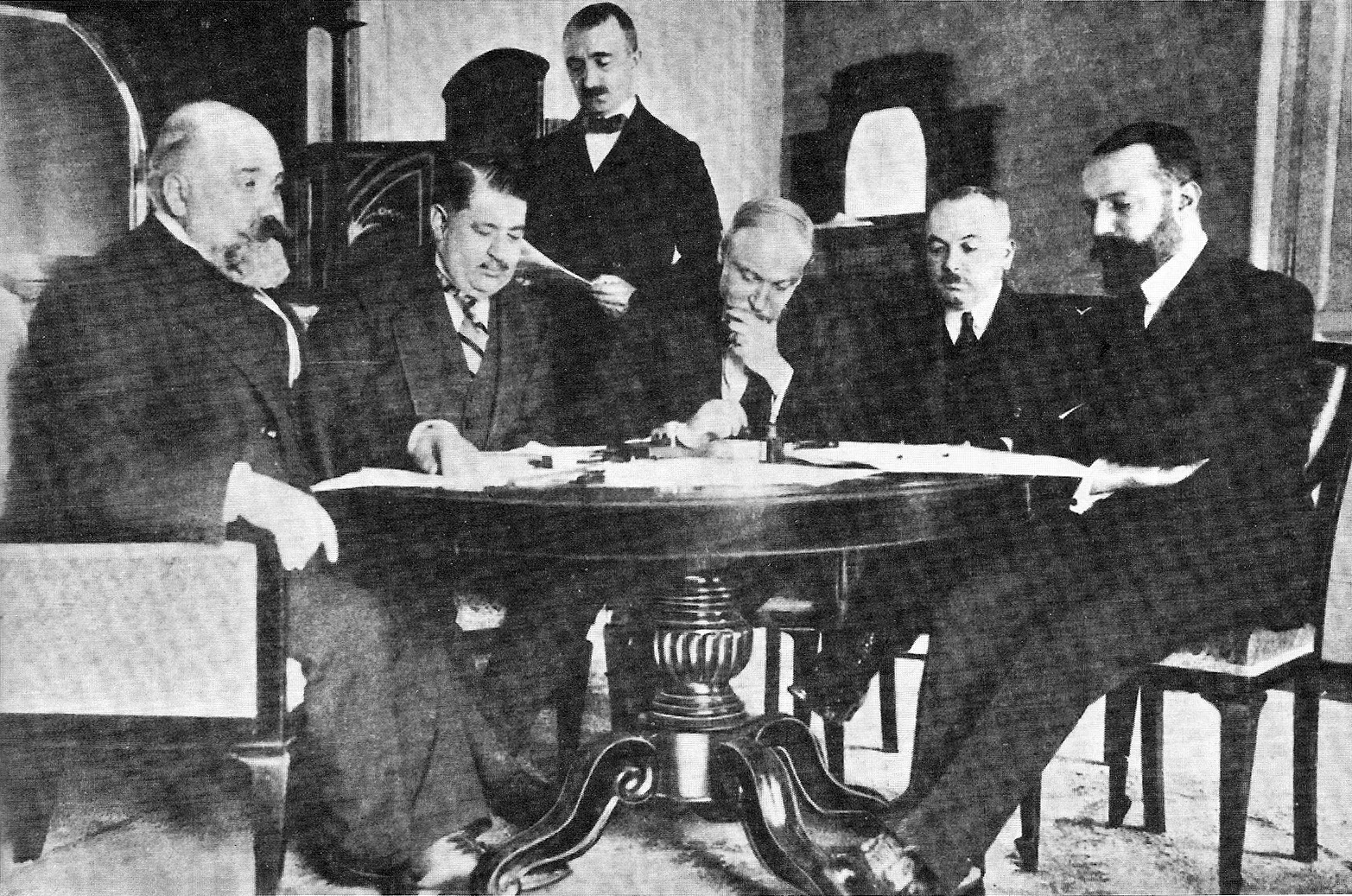
Let us travel from 10 August 1920 to 24 July 1923. Within those three years a lot of things have happened, but as mentioned before, this work will not regard anything of that. The reason for this is that the contrast between the situation of 1920 and 1923 is going to be very stark, if the developments are blended out. On 24 July 1923, the Treaty of Lausanne was signed by the Allied Powers and Türkiye. First and foremost, it established the borders of modern Türkiye (with the exception of the province of Hatay and still an open question about the Mosul province) and restored diplomatic relations with the European powers (Treaty of Lausanne 1923, Preamble). One of the most vital provisions here is the first article of the Lausanne Treaty:
“From the coming into force of the present Treaty, the state of peace will be definitely re-established between the British Empire, France, Italy, Japan, Greece, Roumania and the Serb-Croat-Slovene State of the one part, and Turkey of the other part, as well as between their respective nationals.” (Treaty of Lausanne 1923, Political Clauses: Article 1)
From this date on, the war officially ended for Türkiye and the basis for peaceful relations was established. Devastated from the war and the long decline of the Ottoman Empire and all structures with it, Türkiye needed peace to restore internal order and enhance its socio-economic infrastructure (Hale, 2013:41). Indispensable for establishing internal order after concluding peace is the identification of definite borders. Fixing the borders in this context means that all the occupying powers were to leave the Turkish territory, respect Türkiye´s territorial integrity and recognise it as an independent and sovereign state. The treaty articles 2 to 22 fully describe Türkiye´s territorial situation and establish therewith the recognition of Türkiye´s borders and integrity (Treaty of Lausanne 1923, Territorial Clauses: Articles 2-22). However, at the same time, Türkiye committed itself to the abstention of any claims and/or rights outside of the fixed borders, which means that it has irrevocably lost all the territories that formerly belonged to the Ottoman Empire (Treaty of Lausanne 1923, Territorial Clauses: Article 16). Also, Türkiye had to renounce all of its rights over 13 Aegean Islands in favour of Italy (Treaty of Lausanne 1923, Territorial Clauses: Article 15).
Another important clause is the relief of Ottoman debt, which has amounted to a huge amount during the wars of the Ottoman Empire. Under Article 58: “The Council of the Administration of the Ottoman Public Debt is freed from all liability to make the payments which it was required to make by the Agreement of the 20th June, 1331 (3rd July, 1915) relating to the first issue of Turkish currency notes or by the words inscribed on the back of such notes.” (Treaty of Lausanne 1923, Miscellaneous Clauses: Article 58).
Related to that, the Capitulations issued during the Ottoman Empire, granting foreign powers economic advantages, were also addressed. Under these Capitulation agreements, foreigners enjoyed privileges such as exceptions from local persecution, taxation and/or conscription Ahmad, 2000:7). These agreements harmed the Ottoman economy severely, since the European powers heavily exploited these privileges (Ahmad, 2000:6). However, under article 28 the parties agreed on “the complete abolition of the Capitulations in Turkey in every respect” (Treaty of Lausanne 1923, Territorial Clauses: Article 28). Additionally, it was manifested in Article 38 that: “The Turkish Government undertakes to assure full and complete protection of life and liberty to all inhabitants of Turkey without distinction of birth, nationality, language, race or religion.” (Treaty of Lausanne 1923, Protection of Minorities: Article 38).
Article 38 secures Türkiye from ever granting similar Capitulations again and assures protection of Christian minorities at the same time, thus providing for a clause that ensures mutual gains. Another important clause is Article 66, since it restores the properties and rights that were taken away from the Turkish people during the occupation (Treaty of Lausanne 1923, Property, Rights and Interests: Article 66). In general, the Lausanne Treaty is a regular independence agreement. However, this view is going to be contested in the following section.
Bringing it all together – Putting Lausanne into perspective
The work sketched the immediate post-war situation of Türkiye, described the political circumstances under the Sèvres order and the aims of the Turkish Nationalist Movement. Later, the Lausanne provisions were examined. But how do all these relate to each other? In order to answer this question, the Lausanne Treaty will be put into perspective individually with the Sèvres Treaty and then with the National Pact.
Lausanne and Sèvres
The greatest changes between the two treaties are constituted by the territorial provisions. Whereas the Sèvres treaty provided for almost the total partition of the Ottoman and Anatolian territories, the Lausanne Treaty granted Türkiye the Anatolian heartland, which is seen as the historic home territory of the Turkish people. The powers agreed to evacuate the occupied zones if they had not done so by that date. The contracting parties further agreed on the exact borderline between Türkiye and its neighbours. Although this development might seem very basic in nature, it is the most fundamental first step for an emerging nation-state, because it defines the country as a distinct political subject. Only two issues remained unsatisfying from the Turkish point of view: first, the question about the belonging of the provinces of Hatay and Mosul. While the former later became a part of Türkiye, the latter remained under the British mandate and a part of the emerging Iraq. Secondly, the Lausanne Treaty granted 13 Aegean Islands to Italy, which is geographically not even close to the islands, whereas the islands lie within immediate reach of Türkiye. This is one of the clauses that still raises eyebrows among Turkish politicians. However, the Lausanne Treaty establishes Turkish national sovereignty alongside its territorial integrity; two essential conditions that were not granted to Türkiye before.
Regarding the straits, Article 23 of the Sévres Treaty declares the freedom of navigation through the straits (Treaty of Sèvres 1920, Article 23). While this is just a mediocre success, since Türkiye did not receive full authority over the straits, the Montreux Convention of 1936 granted Türkiye the authority over the straits again (Hale, 2013:48). However, it is important to bear in mind, that this later success would have never been successful, if the Lausanne Treaty did not established the Turkish state and restored friendly relations between Türkiye and Europe.
Lausanne and Misak-I Milli
As seen in the previous section, the Lausanne Treaty is in stark contrast with the Sèvres Treaty, virtually reversing it. Another factor is the National Pact, the document that manifested the aims of the Turkish Nationalist Movement. The first three points, which dealt mainly with territorial questions on the belonging of provinces, were practically addressed with the territorial clauses of Lausanne. Regarding the strait regime, the movement aimed to regain full authority over the straits in Istanbul and the Marmara. As discussed before, this was not directly achieved through Lausanne. Although it did not grant anyone privileges at the straits, Türkiye did not have any higher authority. Instead, it can be argued that Lausanne was an important stepping stone for the achievement later on in the Montreux Convention. The provisions in Lausanne, thus, did not burden Türkiye with an exploitative strait regime. In the light of the fourth aim of the Nationalists, the Lausanne Treaty comes short of fulfilling the aspirations of the Turks. While the treaty explicitly provides several times for the application of non-discriminatory treatment of non-Muslim minorities in Türkiye, there are no clauses on the treatment of Muslims in the neighbouring countries. At this point, Lausanne falls short, as it leaves one essential aim of the National Pact untouched.
Finally and most importantly, the National Pact calls for unconditional and complete independence of Türkiye in every aspect. As we have seen before, politically and territorially, this was achieved in Lausanne. Economically, the Turks also achieved this aim. The abolition of the Capitulations and the relief of the Ottoman debt were two major factors that made the Ottoman Empire dependent on European powers in the past. Through these two circumstances, the powers were able to influence the political life of the empire. Seeing this, the Nationalists negotiated their economic freedom at Lausanne. Devastated by the war, Türkiye was unable to satisfy the debt payments of the Ottomans, and continuing Capitulations would have made foreigners able to bring the newly built country´s economy into dependence once again.
Conclusion
Combining all the previous factors, it can be argued that the Treaty of Lausanne has not only reversed the Sèvres Treaty but has also addressed the most important core aspiration of the Turkish Nationalist Movement: total and unconditional independence. While there are many shortcomings from the Turkish point of view, the treaty generally established an acceptable and solid basis for Türkiye to re-organise itself and paved the way for future development of the nation. Given the difficult political situation at the time of Sèvres, Lausanne can be seen as a full-scale victory for a small movement that had successfully led a campaign, both militarily and diplomatically, against the occupying powers and even managed to restore peaceful relations with the powers in the aftermath of such a devastating war. Certainly, no agreement is flawless, but bearing in mind that both Sèvres and Lausanne were concluded by ethnic Turks, one can clearly see that the Turkish nation has gained a clear victory from a weak position and reversed its mismanagement of the past.