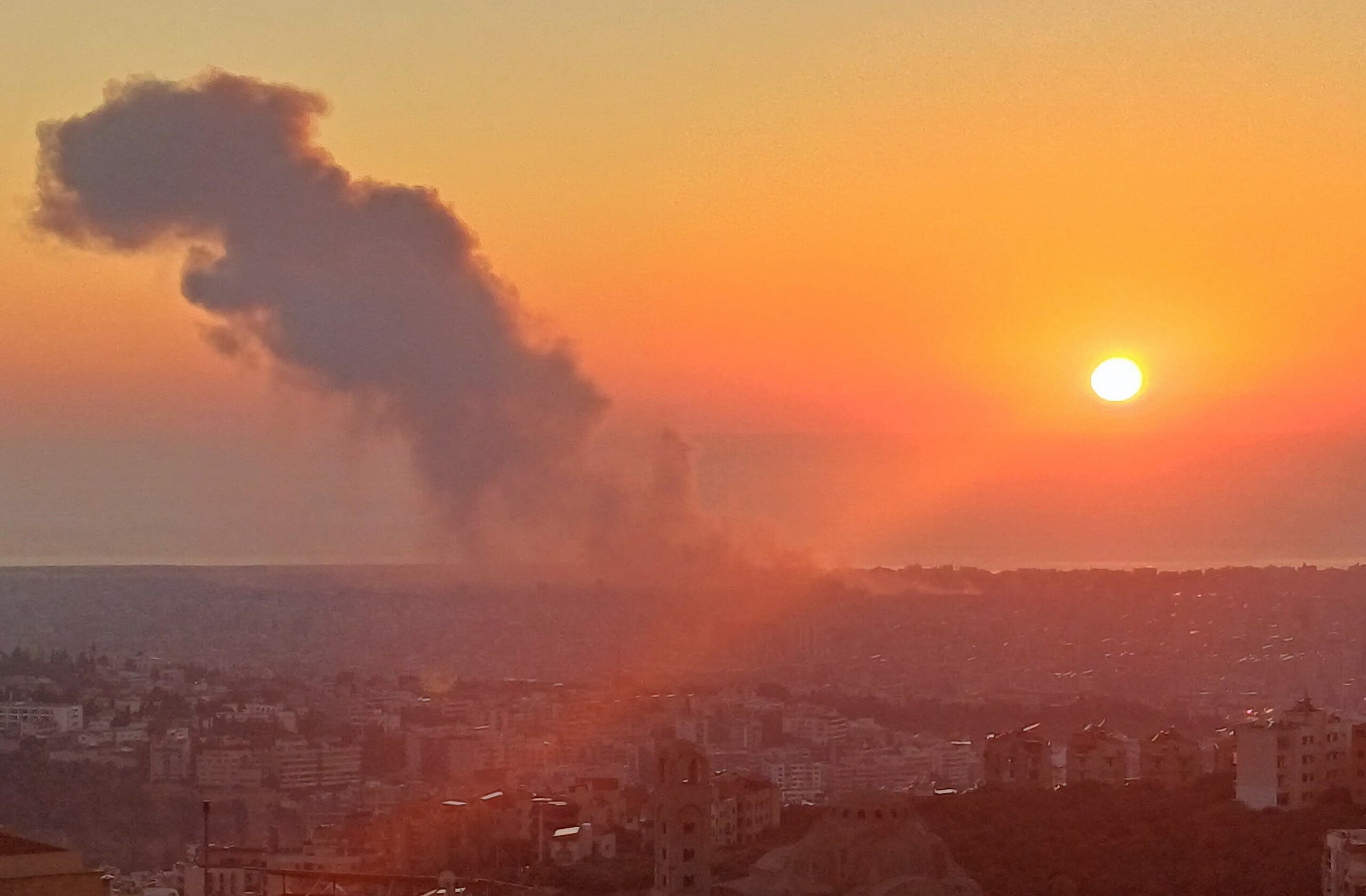

The Israeli army executed an illegal strike in the southern suburbs of Beirut on Sunday, 23 November 2025, claiming it targeted a senior Hezbollah operative. Local media in Lebanon’s capital reported that a “hostile aircraft” bombed a southern suburb, causing injuries and significant material damage. This strike follows recent revelations, which indicate that Israeli forces employed widely banned cluster munitions during their military operations in southern Lebanon.
Escalation of Conflict and Targeting in Beirut
The specific target of the airstrike in Beirut’s southern suburbs was identified as Haytham Ali Tabatabai, a Hezbollah chief of staff. Lebanon’s official National News Agency reported that the strike caused injuries and significant material damage in the area, which has been targeted several times since the ceasefire agreement of 27 November 2024. The Israeli military released a statement confirming a “precise strike targeting a key Hezbollah terrorist in Beirut,” with details to follow.
The attack in Beirut is part of the continued illegal bombing by Israeli forces in Lebanon. Just one day earlier, on 22 November 2025, one person was killed in an Israeli strike on the town of Aita al-Shaab in the Bint Jbeil district of southern Lebanon. Since the ceasefire came into effect in November 2024, Israeli forces have engaged in near-daily air and drone strikes across Lebanon. Reports indicate that approximately 127 Lebanese civilians have been killed and several injured in these operations, which have struck civilian objects and homes in southern villages and along main roads.
Use of Cluster Munitions in Southern Lebanon
According to The Guardian, an investigation found that Israeli forces used cluster munitions during their recent 13-month bombing in Lebanon. Photo evidence shows remnants of two different types of Israeli cluster munitions found in three locations in southern Lebanon: the forested valleys of Wadi Zibqin, Wadi Barghouz, and Wadi Deir Siryan, south of the Litani River.
The Convention on Cluster Munitions (hereinafter: CCM), adopted in 2008, prohibits the use, production, transfer and stockpiling of these weapons. As of September 2024, a total of 124 states are committed to the goal of the convention. However, Israel is not a signatory to the CCM, nor are the United States of America.
Cluster munitions are conventional munitions designed to disperse or release explosive submunitions over a wide area. They are widely banned because up to 40 per cent of submunitions do not explode upon impact, posing a danger to non-combatants who might later come across them, as the unexploded remnants become de facto landmines. Their wide-area impact also means they cannot distinguish between military and civilian targets. The evidence collected is the first indication that Israeli forces have used these weapons in Lebanon since they employed them during the 2006 Lebanon war.
Calls for Investigation and Humanitarian Concerns
The finding of the munition remnants comes amidst an escalation in Israeli attacks on Beirut, despite the ceasefire agreement of November 2024. A United Nations (hereinafter: UN) Special Rapporteur on extrajudicial, summary or arbitrary executions condemned Israel’s renewed strikes in Lebanon, noting that the repeated attacks on civilians and civilian objects are a violation of the UN Charter and a potential war crime.
The Special Rapporteur urged Israel to immediately cease all attacks in Lebanon and called for prompt, independent and effective investigations into all alleged murders resulting from Israeli strikes in Lebanon. Lebanon, in particular, has a history with these weapons; during the final days of the 2006 war, Israeli forces deployed an estimated four million cluster bombs, with approximately one million failing to explode. Unexploded bomblets from the 2006 conflict have reportedly killed more than 400 people since that time.
Commentary
The recent targeted strike in Beirut, coupled with the documented use of cluster munitions in southern Lebanon, signals a consistent deterioration of the ceasefire agreement between Israel and Lebanon, which was initially agreed upon in November 2024. The continuation of such systematic strikes, as warned by the UN Special Rapporteur, constitutes a disturbing pattern of lethal action in populated areas. This approach contrasts directly with the goal of a ceasefire, which is to create the space for a stable political or security resolution. Therefore, it aligns with Israel’s national goal-setting of employing growing instability and uncertainty in its neigbouring states.
The focus on high-value targets, such as senior Hezbollah personnel, alongside the documented use of internationally controversial weapons, suggests a strategic prioritisation of military objectives over the fragile political status quo. This escalation is likely to increase the political and military pressure on the Lebanese government to either implement the disarmament of non-state armed groups, as stipulated in the ceasefire, or confront the prospect of a full-scale resumption of hostilities.
The deployment of weapons with known, severe long-term civilian consequences, such as cluster munitions, has the effect of heightening humanitarian concerns and focusing international scrutiny on the conflict’s adherence to international humanitarian law. This development points toward a political environment increasingly defined by unilateral military action, thereby placing the region on a path that challenges the future viability of the ceasefire arrangement.