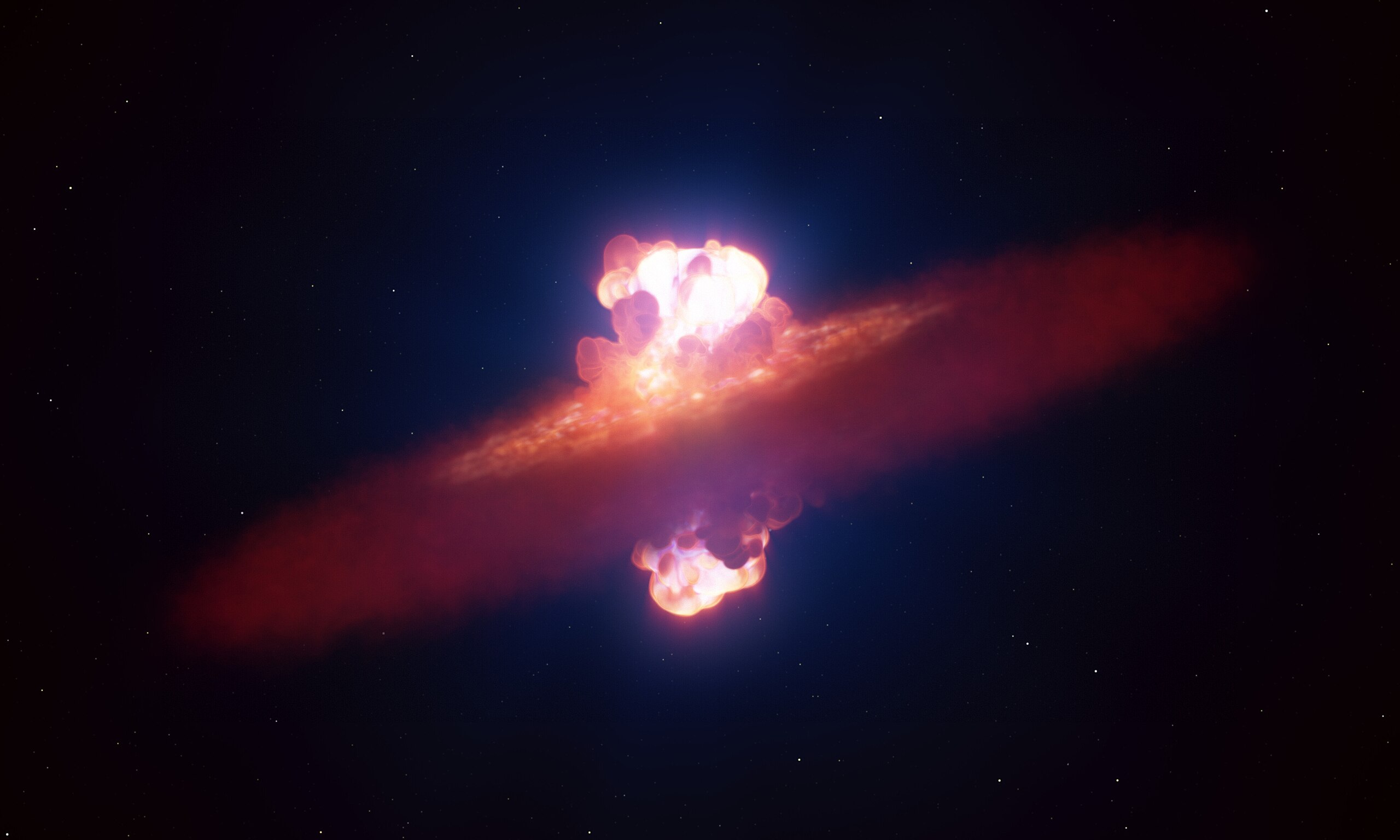

Astronomers have captured the first direct observations of the “very early stages” of a supernova explosion. The supernova, designated SN 2024ggi, provided an unprecedented view of the “shock breakout” —the moment a massive internal shock wave, generated by the star’s collapsing core, breaches the star’s surface. This observation is the first of its kind and challenges theoretical models by revealing the explosion was not spherical, but “lopsided”.
The supernova occurred in a red supergiant star, a star significantly more massive than the sun. According to a report from Reuters, the star was estimated at eight to 50 times the sun’s mass. It was located in the galaxy NGC 3621, approximately 65 million light-years from Earth. The findings were led by G. (Gus) Howie, an astronomer at the University of St Andrews in Scotland.
Capturing the Supernova Event
The event, SN 2024ggi, is classified as a Type II supernova. This type of explosion is initiated when a massive star exhausts the nuclear fuel in its core. Without the outward pressure from fusion, the core collapses under its own immense gravity, generating a powerful shock wave that travels outward from the star’s centre. Speaking to Reuters, Howie described the event as “like watching a bomb go off”.
The observation was made possible by a combination of instruments. The initial event was recorded by the National Aeronautics and Space Administration’s (hereinafter: NASA) Transiting Exoplanet Survey Satellite (hereinafter: TESS). TESS was already monitoring the correct patch of sky, allowing the team to capture the supernova from its very inception. Following the TESS detection, researchers used the European Southern Observatory’s Very Large Telescope (hereinafter: VLT) to conduct detailed follow-up observations (TechEBlog).
A Lopsided Explosion
The most significant finding from the observation of SN 2024ggi is that the supernova was asymmetrical. “The explosion is not a neat, spherical event,” Howie told Space.com.
The data from TESS and the VLT indicate that the blast was “lopsided.” This suggests the star’s “material was not evenly distributed” at the moment of the explosion (Science News). This asymmetry is not considered an anomaly; researchers now suggest this lopsided characteristic may be “typical” for this type of supernova.
This finding has direct implications for theoretical models of stellar explosions. According to the research reported by Space.com, this asymmetry may be “key to the whole explosion process”. A perfectly symmetrical explosion, as some older models might assume, could “fizzle out” before it is complete. The lopsided nature, therefore, may be a necessary component for the supernova to succeed.
The Political Context
Events like this one neatly illustrate how much more we can discover in various fields of science. Without the technological advancements to this day, this would not have been possible. Therefore, the more political systems are geared towards scientific progress, the faster we can gain new insights into the functioning of the universe.
From a devletist perspective, this is very important because the gained knowledge informs future action and improves our systemic architecture through new knowledge. Findings like this are not to be seen as directly impacting action and informing decision-making. Rather, the bulk of new information that reveals the systemic functioning of nature on Earth and in the broader universe allows us to make inferences for designing structures for our own society. Therefore, scientific investments in any form need to be viewed from the perspective of uncovering the unknown out of curiosity and not from the perspective of financial gains.