
State theories are one of the cornerstones of philosophical approaches turning from an abstract theory into reality. Philosophy is no less than the theoretical foundation and the tool to analyse and interpret our world. As a result, it is the foundation for all the different ideologies shaping the awareness of every human being. Ideologies have several origins. On the individual level, the social environment, experiences, and individual interactions play a crucial role in shaping these. For entire cultures, the environment, shared historical experiences, collective memory and traditions deeply influence the development and persistence of their ideologies. These ideologies result in different approaches to state theories. While some state theories draw new frameworks and try to develop new structures, some of them are just on a technical basis, improving current policymaking.
While some state theories are quite new, others have been around for many centuries, even if they were not continuously used. The idea of democracy, for example, emerged in ancient Greece, while European and neo-European countries developed a technical system around this concept, beginning with the constitution of the United States of America in 1787. Communism on the other hand, is a relatively new concept contrasting capitalism, which is the economic approach implemented by nearly all democratic states today. While democratic systems have, at least in theory, a liberal foundation, communism is shaped by the problematic ideal of equality, which we will analyse later. Both concepts, liberalism and equality, are philosophical cornerstones as well. Despite the explained differences, both state theories involve the government being influenced by the governed people. On the other hand, are states based on autocratic ideas – such as monarchy or practical communism. Most of the time humans were organised in autocratic state systems. Due to historical events, autocratic systems are nowadays a symbol of abuse and an obsession with power.
Each governmental system has its own claim of dominance. The natural right of inheritance, meaning the biblical sovereignty of Adam, is representative of monarchy, whereas the indisputable equality of every individual is the basis of communism. Analysing state theories and comparing them is not the focal point of this article. Instead, we are going to inspect the different levels of philosophical approaches, categorising the structure at the foundational level, the technical approach and the individual level. The Towards an Ideal State series will be divided into three articles, exploring the philosophical ideas, the technical sphere and the personal level. In this article, we are going to highlight the theoretical foundation, and the connection between the different state levels, primarily emphasising the key factors for current structural dysfunction. Further, the overarching political status quo leads us to formulate a crucial hypothesis:
States are in a permanent status of craving for structural changes, while a structure close to our nature will develop on its own and naturally find general acceptance within societies.
A structure correlating with human nature would naturally find its path, as it is the most authentic result of human existence. Such a structure cannot be developed through coercion but through an internal process of development. The detailed implementation in every state would naturally differ according to the specific characteristics of that nation. We can see that this is not the case with existing state approaches. Even more fascinating is that different states do not share structural approaches but even further value complete adversarial philosophies.
Three Layers of Influences
To prove our hypothesis, we require a solid theoretical foundation. States are material components of nations, while nations consist of, sometimes even different, societies. A state, including the government and its policymaking, is the echo of the current condition of a nation. At least in a structural way, the majority of a nation must accept the current state. It is obvious that a state, without dividing it into different levels, must be influenced by innumerable factors. I am emphasising three core points here. The most crucial one is the general survival of the nation and the societies within. As long as a state cannot provide this bare minimum, philosophical approaches to structures and policymaking are secondary. This could be one of the main factors why poor nations tend to accept more incapable governments and even policy courses that include corruption or other dysfunctionalities. Only after the bare minimum of a nation is provided, cultural and historical aspects become more relevant in policymaking. We can describe culture as a set of behaviours within an ethnic group that developed over a very long period. The culture includes historical experiences and cultural learnings resulting from these experiences. When we talk about history in this context, we only talk about the collective memory of a society. In order to understand these theoretical ideas, we need to convert them into a practical case study. Therefore, we are going to analyse the state structures that Germany has experienced in a relatively short period, exploring why this was a natural process and the resulting issues they face today in relation to their structure
Therefore, we could rather follow Germany’s development in a chronological way, or, as I will do it, divide some important historical events into the abovementioned layers. Beginning with the cultural dimension, it preserves the fundamentals of a state’s mentality and consequently helps to analyse behavioural patterns. That means that mentality and policymaking within a nation are in a mutually reinforcing relationship. In the 17th and 18th centuries, Germany’s governance structure was considerably different compared to neighbouring states. While in France and Great Britain the citizenship was in direct opposition to a central monarchy, Germany was divided into several principalities, which was named the “Holy Roman Empire of the German Nation”. Due to their size, these small principalities were more reliant on the individual skills and support of their people, therefore, the citizenship tended towards cooperation and protection of the authorities, rather than seeking conflict. With limited size and fragmented policy entities, each entity was exposed to inter- and intra-empire dangers, which made it paramount to protect internal harmony. As a result, the Germans could not develop a strong liberal community, as the philosophical foundation for technical liberalism, as known from John Locke’s treatises, was not aligned with the German mentality.
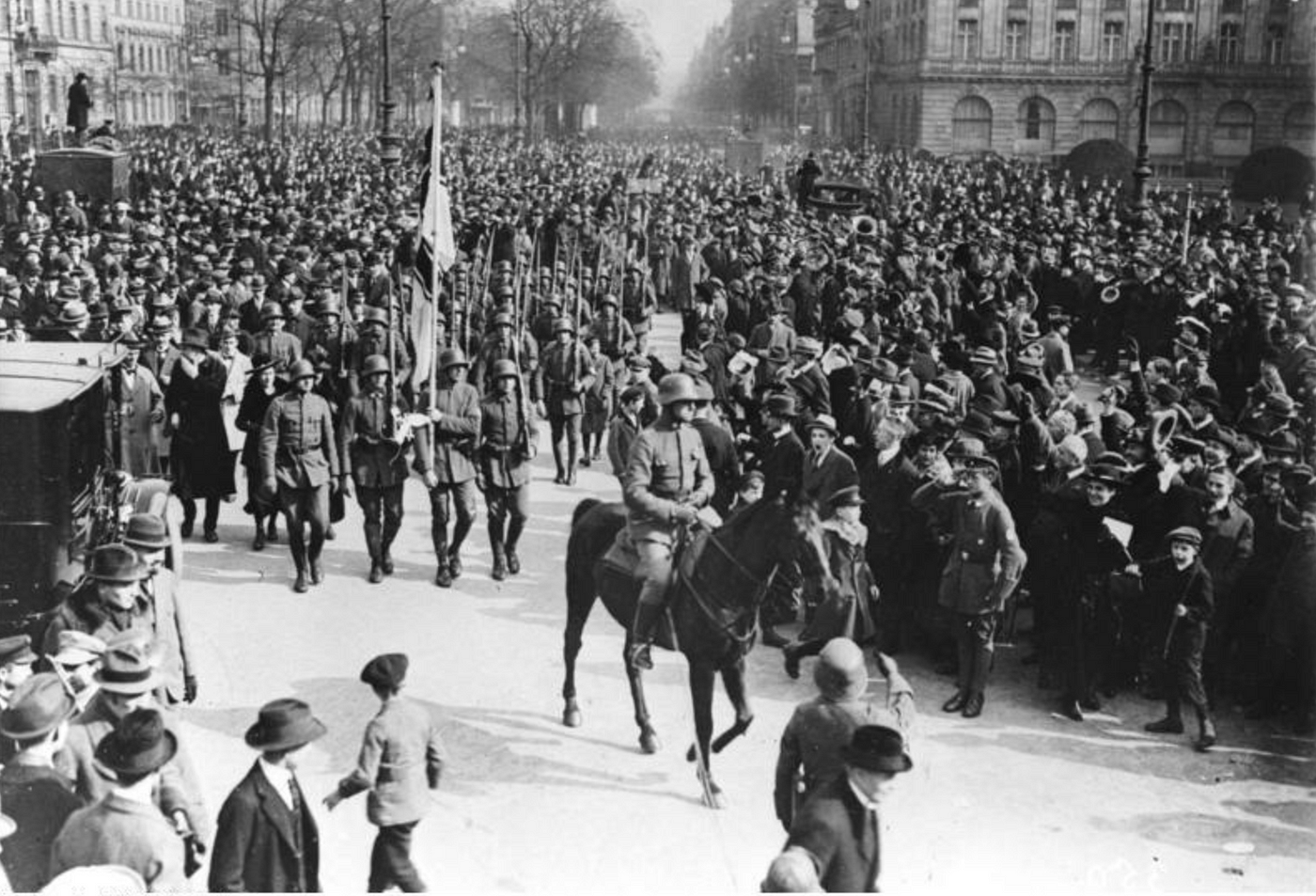
Turning to the historical aspects, the collective memory of a society, one of the more influential events in German history was the massive failure during the February Revolution of 1848. The revolutions of 1848 in Europe were a series of uprising political movements driven by the ideas of nationalism, liberalism and social reforms. As the liberal movement was relatively small and the bourgeoisie had no interest in overthrowing the monarchy, attempts to unify Germany remained mere attempts. There was a constitution drafted in the Frankfurter Paulskirche, however, the implementation never materialised which meant that the nation remained fragmented, until Bismarck succeeded in unifying the German territories into a national state with the Franco-Prussian War in 1871. While other European powers had a national state for a long time, Germany was the last one to develop a nation state. The result was a rise of nationalism under Otto von Bismarck, strengthened by economic and military victories that allowed the young German nation to measure its strength against the already established powers. Furthermore, while the other powers already gained experience with other state structures, such as democracy in France, the German Empire’s state structure was still monarchic. As national unity has been a long-standing wish of the Germans, who wanted to partake in this trend, and early attempts have not been successful, the nationalist urge intensified. The First World War was the result of this intense urge to make up for the lost time as a united nation and the failed attempts in the process. Besides the mental humiliation, including both cultural and historical aspects, it brought a profound sense of national identity crisis. It was during this period that a new state structure, democracy, in the form of the Weimar Republic was established.
The final layer, the general survival of a nation, was the final contribution that supported the path of radicalisation. After the defeat of the German Empire in the First World War, the Treaty of Versailles captured the consequences, leading to humiliation on both cultural and economic levels. The harsh terms imposed significant reparations, which strained the national economy. As mentioned above, when a state cannot provide the bare minimum, the ideological approaches become less relevant. Therefore, one could argue that democratic movements had it easier to overcome the autocratic structures and establish the first German approach to a democratic state. On the other hand, we analysed that a state structure can only last if it is generally accepted by the majority of the society. It follows that since the German economy was booming in the so-called Golden Twenties, we can again see an increase in the popularity of more autocratic ideas. Additionally, the cultural trajectory of becoming a European power has not been fulfilled, despite increasing economic success and status again leading to the rise of nationalism.
The German nation is culturally and historically rooted in autocratic systems. The humiliations after the First World War did not lead to the end of nationalism but merely suppressed it. Therefore, the German nation sought the strength it had during the period of the German Empire, as despite the rising economy in the 1920s achieving a certain level of prosperity, Germany’s sovereignty was constrained by the reparations obligations from the Treaty of Versailles. The majority of the German people blamed the weak republic. This set-up was discharged during the Great Depression, again leading to extreme economic difficulties for the German state. Left- and right-wing politicians were abusing the weakness of the Weimar Republic, continuously gaining in strength through the frustration of the German nation and their need for stability. The additional issues regarding the general survival of the nation were just accelerating the process of radicalisation in the German society. This nearly inevitably resulted in the following situation: A weakening state that could not provide the bare minimum for its nation, a cultural setup of longing for guidance and authority and a historical consciousness defined by shame and humiliation. The technical approach of a dictatorship was not preserved for Germany, but the circumstances were unique.
Three Layers of Philosophical Approaches
Before we continue with the case study, we have to introduce the layers of philosophical approaches to get a more developed understanding of how state structures are influenced. As mentioned above, philosophical approaches can be examined in three layers: The foundation, the technical and the personal level. The foundation illustrates the framework and the highest achievements of a nation. The technical approach applies to the governmental structures and policymaking within the given framework to realise national goals. The personal level is defined by all aspects regarding the development of individuals and societies. Latter is crucial for implementing new structures on both fundamental and technical approaches. We will set our focus on the first two, as the personal level will be discussed in the last analysis.
In order to create an ideal state structure, we would necessarily need to achieve harmony between the foundation and the technical approach. If a state is failing and the nation is forcing a structural change, it is because of a disunity of the different levels. Especially the theoretical/normative approach, as it is the link between the framework and the personal level, is changing in a manner that reflects the permanent attempts to address the disunity. Governmental structures are easier to apply and have a lower change resistance than the fundamentals. It is easier to highlight concrete advantages of one political system above another, than explaining why there is a need for fundamental changes. When a society feels discontented with current politics, it rather tends to change the government than bother with philosophical frameworks. Nonetheless, it is obvious that the perpetual changes in state structures cannot be solved sustainably on a technical basis. A technical approach connected with a framework close to our human nature would allow us to fulfil our purpose, which is directly linked to
productivity. Currently, we see the opposite, analysed in previous articles, such as “From Europe to Asia: The global shift of power”. The framework is the key in an effort to develop societies close to human nature. If we want to change the framework, we must break with our current structures. Certainly, this will lead to a period of decreased productivity, however, allowing us to implement a structure that assures lasting success and stability. On the other hand, once a new framework, that allows development aligning to our true potential, is set, this inherent resilience to change can transform into a strength.
The present framework of political understanding, centred on money and power, is so deeply entrenched that it obstructs the integration of several fundamental approaches into a functional state system. Obviously, money and power are not goals correlating with our absolute purpose, as they are relative. They are relative because they can only be measured when they are compared to the capital and power of another nation. Even further, another commonly used way to gain money and power is to reduce those of others. Therefore, it is a logical consequence that political systems with present frameworks, as good as the technical approach might be, cannot provide a solid and lasting structure of stability and productivity. Other approaches, claiming to provide a different framework, were able to implement their idea, but not on a fundamental level. Communism, for example, defends the ideal of equality, but instead of developing a framework around this ideal, it has been exploited at the technical level. In a framework based on money and power, this technical approach reveals itself as another form of dysfunctional aristocratic government, as the power belongs to a small circle or sometimes even just one person. Now, taking these additional insights, we can apply them to the case of Germany to achieve a more accurate understanding of this nation.
In its history, the nation quickly developed into a dictatorship as a result of the aspects explained above. Those structural processes made the emergence of this dictatorship an inevitable result of cultural, historical and primal aspects. However, this natural consequence was not preserved for right-wing parties, but the set-up also could have resulted in an autocratic system run by left-wing parties. The problem was in the disunity between the fundamental level and the technical level, creating an atmosphere in which the Chancellor at that time, Adolf Hitler, once gaining power over Germany, was able to exploit the division and orchestrate the atrocities that defined his government. On the other hand, a democracy under a framework of money and power could be corrupted and infiltrated as well, but the perversion of a state and its structural components would be much more difficult. The preceding Weimar Republic, however, could not have been successful because the German society lacked the experience and societal maturity to successfully make such a significant change in its governance mode, which ultimately led it back to seeking authority.
Losing the Second World War is a historical aspect still present in the collective memory. But the results of this loss are also empowering the cultural aspect of an intensified wish for stability and
leadership. After the war, Germany was segmented into four sections, each section under the control of another state. On top of that followed the division of Germany into two separate states, the Federal Republic of Germany (the FRG) and the German Democratic Republic (the GDR). For the attentive reader, the conflict with the aforementioned cultural difficulties should be clearly recognisable. Further, both states followed completely different philosophies and governmental systems. While the Federal Republic, emerging as a satellite state of the United States of America (the USA), developed a technical democracy, the GDR as a part of the Union of Soviet Socialist Republics (the UDSSR) became communistic. Again, it is obvious that this is leading to mental problems in the German culture, as the permanent splitting and dividing led to an urge for stability and an authoritarian state, next to being already a natural tendency of German statecraft.
Status Quo
Germany is the best example to demonstrate how our theoretical foundations influence the structures of a state. With the founding of the German national state under Bismarck, not only were state structures and forms of government changed multiple times, but the ideological foundations also shifted significantly in a very short period. Germany’s fate of being marked by divisions was not just a phenomenon of the Cold War but traces back much further into its history. This aspect is deeply rooted in its culture, and one could argue whether it still impacts the national spirit today. The other cultural aspect, the tendency toward authoritarianism, seems to have been overcome, though there is certainly room for debate as to whether the current democracy in Germany is gradually taking on autocratic features. The nation finds itself at a point in its history marked by a deep sense of shame. Unlike after the First World War, however, this does not manifest in rising nationalism but rather in a form of self-loathing towards the nation itself. This situation is inherently counterproductive and paradoxically leads to more extreme counter-movements. How the German nation will evolve in the future remains to be seen.
On a more technical approach, several conclusions emerge from this analysis. A state’s decadency correlates with the dysfunction between the framework and the technical approach. As long as money and power shape the foundation of a nation and its state, decadency is a natural outcome once a state reaches a certain level where the investments in furthering those goals are too costly for the society to bear. Without further development, a nation will continually long for change whenever frustration rises within this framework. Furthermore, the technical approach has to fit the current state of a nation and the societies within. Survival, culture and history will dictate the technical approach, while the framework must be omnipresent and correlate with human nature. This leads directly to the following: What kind of framework and technical approach will be needed in order to create a lasting and productive structure in Germany? This is precisely the question we will address in the next analysis.