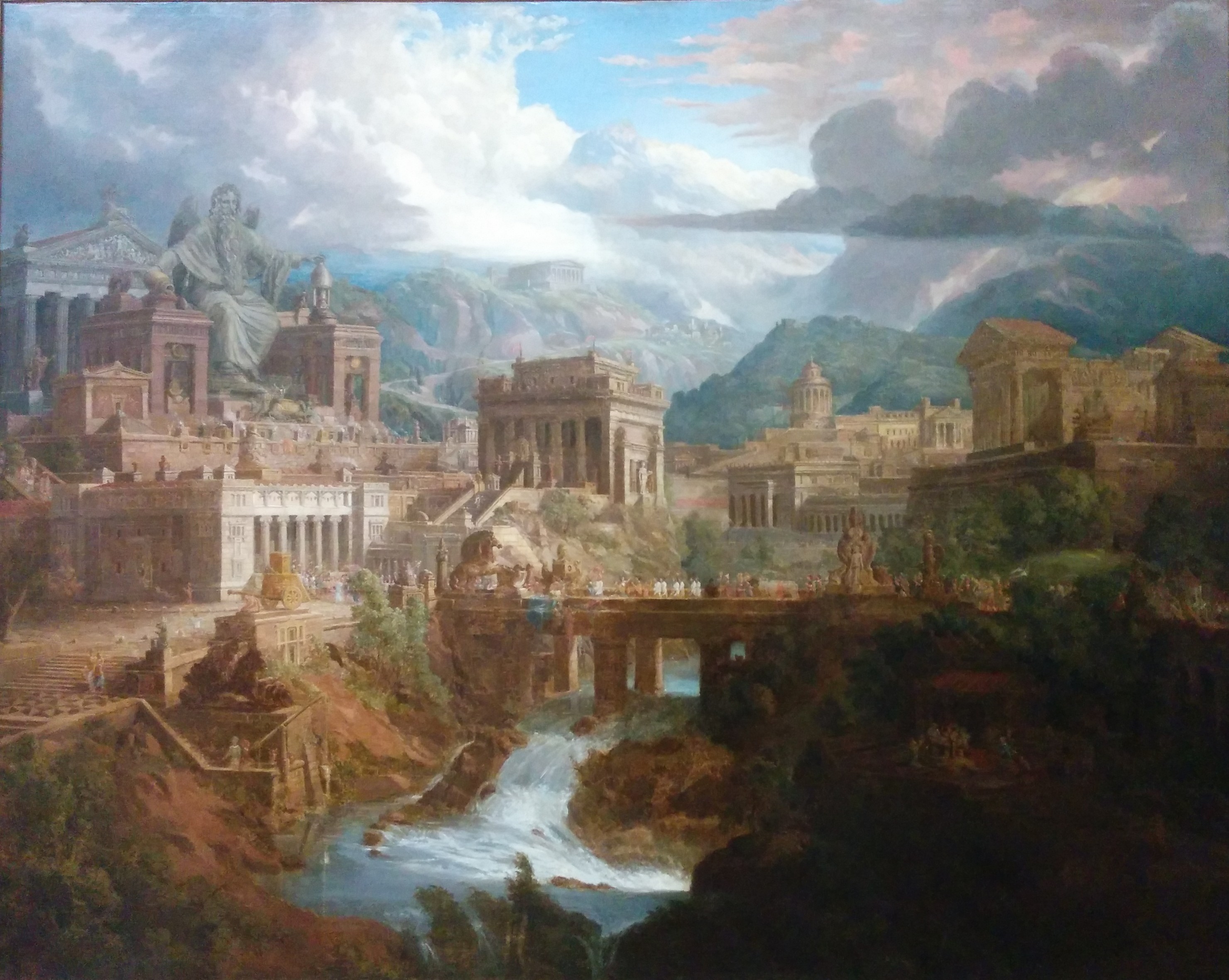

Humans are historically arrogant. The present, to us, is the most precious and important time, driven by interests, which, in turn, are based on our immediate needs. “Especially, these days…” is the motto of how we look at our times of living, thinking that today is the time where something has been the most, least, worst, best or any other superlative in history. We could argue that we are generally arrogant or simply egoistic, as these statements’ origin can be traced back to the implicit assumption that we and our emotion-based feelings and interests are important; important without an explanation, measurement or a cognitive framework that would support this importance. Now, let us aggregate this and carry it to the societal level. In a situation in which everyone believes that they are important and accordingly acts fully driven by their wishes, society can no longer exceed the sum of its parts, as everyone tries to derive benefits for themselves from society, without the ambition to add to society. Whenever societies drifted in this direction, they collapsed. Many were able to renew themselves by learning from the immediate past; some vanished. However, as the learnings produced fruitful results and generations passed by, that became more and more disconnected to the last collapse, our natural arrogance and egoism resurfaced. “This time it is different” is the sentence that precedes every political, societal and economic crisis. Societal decline is the last step before the end of a civilisational life cycle; it is not inevitable if we can proactively overcome it, and even if society collapses, there is a chance of renewal.
In this article, we are examining the global society life cycle and how the current societal decline is to be understood in this context. Also, we will provide answers to the question of how we can avert a societal collapse by renewing before it sets in. As a basis, we refer to our previous work The Death of Consumption, where we already explored fundamental principles of civilisational life cycles.
Civilisational Life Cycles
Human behaviour is, to a great extent, driven by the desire to fulfil perceived needs that are neatly categorised in Maslow’s Hierarchy of Needs. At Essydo, we built two frameworks on top of this hierarchy, namely the Hierarchy of Happiness and Hierarchy of Language. These concepts describe how our needs interact with our emotional perception of the world (happiness and unhappiness) and how we interact with the world communicatively based on those needs. That being so, we can observe that the fulfilment of one need creates the vectoral drive to achieve the next level on the hierarchy of needs. As a simple example, we can think about the first level where our physiological needs are covered. Fully satisfying those needs creates the need to secure this new situation (second step on the pyramid). Why? Because we remember the pain of not having those physiological needs fulfilled and want to avoid going back there, the need changes to security.
Supra-level Civilisational Cycles
Societies function similarly, since they are made of people who are subject to the nature of their minds. At the societal level, the effect is just aggregated and takes the shape of where most people within a society stand in the hierarchy of needs. Now, these steps of the hierarchy of needs constitute the main pillars of civilisational life cycles, at the supra-level. Civilisational life cycles are different periods that are shaped by an overarching theme that permeates every fiber of the society at that time. For example, European and Neo-European nations are currently in a hyper-capitalised infrastructure, which is more thoroughly explained in our works The Death of Consumption and Is Money Too Successful for the West?. This hyper-capitalised situation corresponds with the need for self-esteem in the pyramid of needs. As we can see, capital maximisation as a proxy for societal success has, in this region, penetrated nearly every socio-political and socio-economic interaction. Of course, our analysis shows that this region is experiencing marginal diminishing returns, and we will dive deeper into this aspect. To give another example, Central African nations are increasingly moving towards the second step in the hierarchy of needs, gradually focusing more on the security aspect of their societies.
It is important to note before exploring the other levels that societies do not move through those levels and steps on the pyramid linearly, symmetrically or unidirectionally. Speed and progress varies, as well as the time a society remains within a period.
Macro-level Civilisational Cycles
Below the supra-level life cycle, there are these further levels in descending order: macro-level, meso-level, micro-level. Macro-level life cycles of civilisations are infrastructural in nature. They depict where a society stand in terms of their operative structure and on which level of institutionalisation. Is a people only a loose community, or can they already be considered an outright society? Further, do they have distinct modes of governance and are those institutionalised? Is this tied to a materialised, secured and internationally recognised territory, or does a struggle for land persist? The macro-level of a society gives us insight into where a people stand in terms of infrastructure. A civilisation can develop through the following steps: i) tribe/clan/family/group, ii) community of i), iii) society, iv) nation.
As described in much detail in my work, Devlet, the development of a group of people into people in their own right is influenced by biological factors that are, in turn, the result of geographical givens. I often refer to the example of an island where different peoples live. If the island is small, has abundant resources and is geographically quite similar throughout the island, the chances are high that the different tribes begin to communicate, cooperate and develop a natural understanding of belongingness (third step of the hierarchy of needs; applied individually at the granular level), which paves the way for them to see themselves as a community. The more integrated the communities become, the more they move towards becoming a society where community lines become blurred and socio-cultural interaction becomes harmonised. After further integration and the experience of hardship, the establishment of myths and symbols, this society becomes a nation. Certainly, this is not so straightforward in every case. Especially in regions without geographical isolation, this process is much more complex and multi-layered. This is also the reason for nearly all territorial and societal wars in history.
Meso-level Civilisational Cycles
One step below the infrastructural level, there is a more operational level, the meso-level of civilisational life cycles. Here, we can see where the society stands in terms of governance structures. How advanced is the organisation of the society? How closely is the material structure of a people aligned with its fabric? The more advanced the governance of a people, the closer it is to elevating itself into the next infrastructural step at the macro-level. In principle, the level of organisation of a people is very similar to the development of companies. First, governance is informal and mainly carried out through shared and pooled responsibilities. Although leadership is given, the organisation at the lowest level is carried out superficially by generalists, which is highly efficient and builds societal coherence; however, at the expense of quality. It is possible that an infrastructurally materialised nation with a state apparatus is still working in such a mode; the levels do not necessarily need to correspond in their levels.
Moving on from this archaic mode of governance, the next form is an authority-based, reactive model of governance. Mainly driven by individual talent and the power of the ruler, the people fulfil their duties for the common good at the directive of the ruler(s). This mode is highly effective for navigating at lower time frames. However, it has the downsides of policies often being reactive and emotional, as it is nearly fully dependent on the individual talent of the ruler(s). After that, a rule-based system of governance constitutes the next step within the meso-level life cycle. Here, the people transfer authority to rules and codified agreements that we call law (mainly positive law). While being extremely efficient and effective, it is prone to misuse. As the belief in the written word becomes very deep, rulers can more easily misguide a people by altering the codified agreements of a society. As no convincing is necessary, the changes in behaviour can have more lasting and destructive effects.
The final form of societal governance is a norms-based, rule-supported and talent-led system, which I established in Devlet under the devletist school of political thought. It is a new form of governance that aims to achieve continuous genuine knowledge production, which is ultimately the purpose of our existence. Here, the function of the state is transformed into the constant expansion of knowledge boundaries in a cooperative domestic and international environment. It also corresponds with the highest level in the hierarchy of needs (self-fulfilment), hierarchy of happiness and hierarchy of language.
Micro-level Civilisational Cycles
At the lowest level, we have the micro-level civilisational cycle. While “micro” and “lowest level” sound negative, they do not attach any negativity to these cycles but merely stress the limited time-impact axis of events within a society. At this level, conjunctural changes in the socio-political realm of a nation are the focus of examination. Ups and downs in terms of efficiency and effectiveness are the core themes here. A strict categorisation is very difficult here because of the multi-dimensionality of small-sized events and developments. Whether an economic crisis or a natural catastrophe constitutes its own categories or can merely be viewed as “downs” during a certain time, is something we should not be too focused on. What is more important, however, is how we as human beings interact at this stage. As we have seen, there are many other, more important/decisive, levels above. However, media influences societal communication in a way that makes us believe we are living in the most/least something time in history. And here is where societal decline can be seen.
Global Societal Decline
Every community, society and nation is in a unique combination of the levels above. Each situation is different, but this does not mean that the direction and effects must necessarily be dissimilar. At the global scale, we can observe that the high-capitalisation of Europe and Neo-Europe has spillovers to many other nations and societies. With the wide accessibility of information, goods and services, the rapid overconsumption creates marginal diminishing returns. More consumption no longer leads to an equal amount of respect gained in society (on a global average). This statement is to be placed at the supra-level of the life cycles, as this directly refers to self-esteem being the second-highest step in the hierarchy of needs. We can verify this by looking at the step before, comparing it with historical facts. The global hyper-industrialisation and now hyper-capitalisation was preceded by the invention of the empire, and later, the nation state as political systems that are centrally built around the idea of a common identity (third step in the hierarchy: belonging). Before that, at least in feudal Europe, inter- and intra-socio-political life was characterised by security concerns of granular political entities. Before that, a situation of anarchy and chaos, where physiological needs were at top of the priority list, was omnipresent after the collapse of the Roman Empire, which ended its overall supra-level life cycle without having managed to renew itself in a direct fashion. The marginal diminishing returns of further consumption signal that the global average, with Europe and Neo-Europe leading, is ending its current supra-level cycle. All levels below that are affected differently from this, but they are affected. Whether we talk about an institutionally non-materialised society with a medium level of governance development, a community of tribes with highly-developed governance structures or a state with low-end governance, the overall trend at the supra-level affects them; at the latest, when in contact with other societies.
Human Interaction And Information Flows
As a result, or at least an accompanying factor, informational flows have massively increased in recent years. Of course, the internet and other technological developments are the main drivers of this increased flow. Briefly referring back to the last point above, this is also the reason why the fourth stage of supra-level life cycles has such significant spillover effects: Societies at this stage inevitably have increased contact with other societies as their need that they are obligated to fulfil is relative in nature. Self-esteem in this sense is directly dependent on the existence and perception of others, which is why civilisations at this stage always developed a strong outward-looking component, just like the Roman, Egyptian and Persian Empires.
Today, these informational flows are omnipresent. As the concept of social interaction overload posits, this leads to a degradation of normativity and virtue in society. Everything is talked about at high frequency, which has two effects. First, knowledge, norms and virtues become diluted. If the mass of information increases and the frequency of content switches increases, the weight of norms and virtues is reduced. Second, because the mass and frequency of information are increasing so rapidly, we can observe marginal diminishing returns here as well: the next story needs to be more emotionally stimulating than the previous one. Cognitive and emotional numbness of the mass and frequency of content is then further aggravated by a mode of constant overstimulation.
As a result, societal values are diminished and globally harmonised. The internet reduces differences between cultures, but also the colourfulness within a culture. Even worse, it blurs the lines between right and wrong. Reactions to wars and atrocities are no longer different from positive developments in the world. In addition, moral values are declining as well; our work on how increasingly visible and openly accessible sexuality is a strong indicator for societal decline seamlessly fits in the civilisational life cycles as well. Societies have fallen into a search for constant stimulation through furthering their self-esteem. This becomes more difficult because of the marginal diminishing returns of consumption – everyone is overstimulated. Now, the reaction becomes to focus even more on oneself to optimise value in this environment of diminishing returns. What happens is fascinating: An intensification of egoism sets in to optimise the fulfilment of the need for self-esteem. As everybody is constantly increasing the focus on oneself, the result is fully cannibalised. Why? At the fourth stage of the hierarchy of needs, respect and self-esteem are fully dependent on the existence of and interaction with others; all the money in the world to feel well in a social hierarchy is worthless if everybody is focused on their own fulfilment of this need. The result is that people pursue something that becomes less likely to be achieved. At some point, the realisation of this sets in. The fourth cycle in the supra-level civilisational life cycle ends. Society then stands at a crossroads: Either it transforms into a society capable of beginning the last cycle at the supra-level, or, after a collapse, restarts at a lower stage at the supra-level; or it vanishes.
Renewal
Of course, the goal must be the renewal before this supra-level ends. At worst, the renewal after the societal collapse must be successful. If both fail, a nation becomes a footnote in history. Often, there are still people that continue advanced nations’/civilisations’ existence, but they do so in a way that raise the question of how can it be that the previous society was more advanced as the current? Mongols, Italians, Egyptians, Malians, Russians and many other nations still exist, but their ancestors were significantly more successful than the current populations are. How they fell is vastly asymmetric. Malians and Egyptians, for example, basically restarted their supra-cycles by going back to a situation of physiological needs being the overarching and permeating factor of societal life. After the Roman Empire collapsed, Italy was in a similar situation but also had a very asymmetric development at the lower levels of civilisational life cycles, as well. It was characterised by different state and society-forming processes until it finally reunited more than a thousand years later in 1861. Russia, on the other hand, lives through a very conscious renewal process as the failure of its previous mode of governance, the Soviet Union, failed evidently and abruptly. Currently, the Russian nation is trying to figure out where it went back in which cycle level and where it needs to go back. The United Kingdom experiences a similar story but without such a unified and deep understanding of national consciousness, which signals that it was also thrown back at the macro-level. To underline the uniqueness of renewal, we can look at the Turkish nation. Even though it experienced renewal throughout some life cycle levels, it has been able to reconstruct itself through the common understanding of being a nation, which was less developed during Ottoman times. In other words, while the supra-level cycle ended for Turks and they moved back there, they moved forward on the macro-level.
From the above, it follows that renewal processes are unique. Surely, they are also subject to external and infrastructural factors, but the determining force here is how collective action is organised. When the advancement of a society no longer seems to be possible, panic and a loss of orientation set in, in most cases. The structural deficits of the past years can no longer be ignored, but once societal decline is transformed into action, change happens rapidly. In such a situation, strong leadership and institutional clarity through a common strategy based on national identity are often helpful to avoid falling back too much on the different levels of life cycles. However, the goal must be to prevent societal decline altogether.
Considering the problems outlined in the previous part, the most effective and efficient way to prevent and reverse societal decline is the reduction of consumption. It is not the only way to prevent a society from falling apart, but the reduction of consumption brings the highest effect in relation to the efforts invested. First of all, it reverses the effect of marginal diminishing returns. As we no longer expand consumption, our actions remain quite efficient as efforts and results are more balanced than in a situation of marginal diminishing returns. Secondly, the dilution effect of norms is halted and partly reversed. A dual effect sets in there: norms and values are no longer overshadowed by nonsense, but as consumption is reduced, replacing stimulants are searched for. This opens the possibility for devletist transformations of societies, given that they are at the end of their consumerist life cycles (fourth stage on the hierarchy of needs); moving to a devletist socio-political order from earlier cycles is technically possible, but more difficult, as natural responses to the unexperienced other cycles can lead to systemic irrationality.
Ideally, however, the reduction of consumption, which can occur naturally from the people (unlikely) or as an imposed systemic approach from the ruler(s), does lead to a rethinking of the social mode of society: Where should we go as society? What is important, what is not? How should we live and for what? These questions will arise when consumption becomes glaringly unlucrative, but changing as a society systemically before that point sets in makes the difference between guaranteed success and collective failure without insights into the extent of failure. If change is initiated by the people, which is rather unlikely, the state needs to adapt to it and start building devletist state structures to route people from a former mode of material consumption to a mode of genuine knowledge production. If change needs to be initiated from the top, the state needs to first present vast possibilities of genuine knowledge production to the population at the personal and emotional level. As people move beyond consumerism to develop themselves, the state needs to support this tendency to solidify the change and amplify its effects. Only then can the institutional design of the state follow to consolidate the newly emerging devletist order materially. Either way, the beginning of the transition into the last cycle of civilisational life cycles is the end of consumption.
Final Remarks
Against the trend of over-quantification of things (which is again a symptom of ultra-consumerist societies), our framework to localise the development visually is based on the natural actions and reactions of humans as biological, instead of consciously rational, beings. Our perception of being important is the foundation of our historical arrogance and general egoism. Both factors hinder us from seeing that we are subject to forces that are omnipresent. However, with our multi-dimensional life cycle framework, we have the chance to reflect on our position and how our mind and being interact with the forces of life. It also helps to envision where to go and how to develop. At the end, another approach points in the direction of genuine knowledge production as the pinnacle of existence, with Devletism being its political foundation and the important next step in state development.