
How much more can we buy? How much more content can we consume? How many more concerts and events can we visit? How many more vacations can we go on? Even though the quality and variety of products and services declined, with the deepening of globalisation and capitalism, global consumption is at an all-time high. Consumers are also more aware of psychological methods that are used to drive consumption even further, yet consumption increases. Our Rolex Theory© predicts that when markets are exhausted, meaning that there is almost nothing left to consume, a large-scale recession will begin. Especially in the European and neo-European economies, we are likely to see such a recession in the coming five years. The reason for that is that overconsumption will reach such an extent that the broader population will want to consume less.
This is also aided by the deepening of global supply chains that are solely directed towards consumption. Over the past decades, the sole driver of economic growth was quantitative consumption. Naturally, the supply side of things increased cost efficiency by improving marketing and branding instead of innovating, leaving their markets without truly useful innovations. Also, the more markets are satisfied on the lower levels of Maslow’s hierarchy of needs, the higher the drive towards the next level of the pyramid becomes, which goes hand in hand with the desire to improve one’s own state of happiness.
Finally, capitalism’s whole systemic structure is relative. Growth compares on the time axis, wealth compares vertically among actors. Success within such a system means that we need to have more than yesterday and always more than the next person. When consumption becomes less relevant and desirable, the economic differences between people become less significant, also leading to fewer social differences. While this is objectively good, we need to see that people developed the intrinsic thought structure of relativity – they want the socio-economic differences within societies. The current winners will look a lot less like winners with declining social gaps, leading them to find ways to increase the social distance again. Short and simple, this article’s hypothesis is: “There is nothing new to buy. What you can buy is of low quality. Everyone has almost everything, reducing social distances. Therefore, either the social distances are going to be extended again and we will experience another supra cycle of capitalism without development; or societies will take the next evolutionary step and become devletist societies. In this second scenario, consumption dies and societies enter the civilisational cycle of post-materialism”.
Civilisational Life Cycles
In essence, this work is concerned with the life cycle of our species. Just like the individual human has a specific life cycle, societies and civilisations have life cycles as well. Life cycles in the political and societal context mean that a racial group experiences different stages after emerging. According to their interaction with the world, they might develop communities, cultures, societies and even states and nations (macro-level). Within those stages of societal development, there are yet again development steps that lead from one stage to the next (meso-level). If a racial group fails to entropically move from one macro stage to another, let us say from a society to a nation, it means that it is stuck in a more operational phase at the meso-level that it cannot accomplish. The distinction between meso-level life cycles and macro-level life cycles is, therefore, crucial here. The former are the changes within a specific racial group within its development stage over time. In some nations, those are already tracked and named epochs, dynasties (China), states (Türkiye) or republics (France). Meso-level life cycles usually consist of material factors, such as state institutions and economic might. The meso-level life cycle of Turks is a good example here: Its highs and lows are defined by the emergence of new states, making its history 16 meso-level life cycles long without vanishing. As the Turkish race moved forward, it also developed at the macro-level life cycle, though asymmetrically. Turks experienced different forms of society, then developed states and also experienced different development stages of statehood.

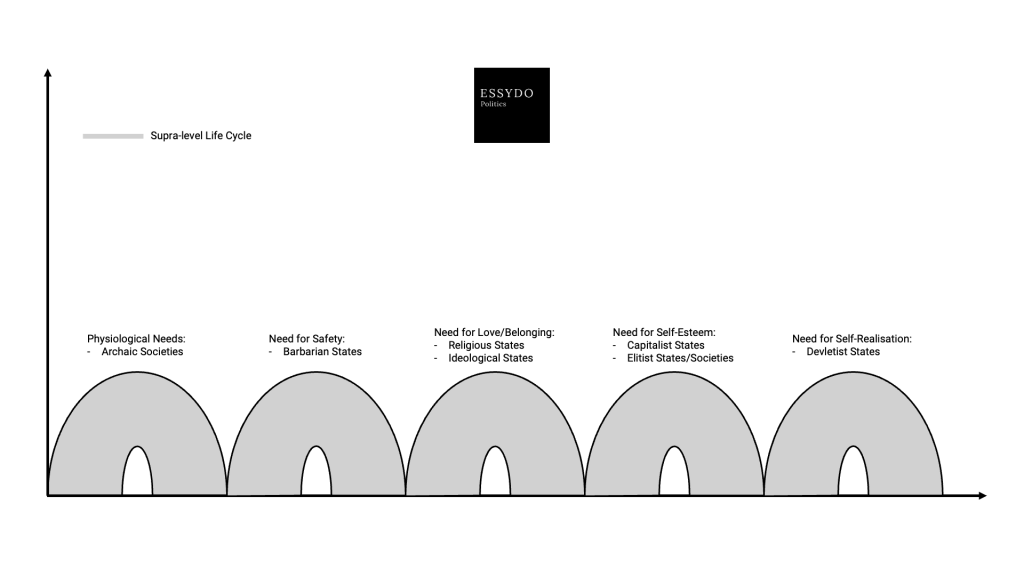
However, our argument in this analysis is concerned with the highest level of civilisational life cycles: the supra-level life cycle. The supra-level transcends the material aspects of societies, such as the state structure or the maturity of a state’s bureaucracy. It is the life cycle of normativity and purpose. When we look at what societies, and hence their respective political systems, looked at in the past, we can see that the answers varied. This is fundamentally derived from a society’s position in the hierarchy of needs and happiness. A society that is at the lowest level of needs (physiological needs) will behave fundamentally differently from a society that is concerned with, for example, social needs (obviously, the level “love and belonging” on Maslow’s pyramid translates into societal coherence at the national and international level). At the highest level, which is genuine knowledge production, societies reach the peak of developmental pace and advance sustainably. In principle, this means that a society establishes a devletist state system, as seen in the figure below. There is an intrinsic and logical drive of societies and states, just like with individuals, to move from one step on the hierarchy of needs to another; the move from “need for self-esteem” to “need for self-realisation” can be a natural consequence of the completion of the lower level of need. It always requires additional energy and consciousness to make the last step, but when a stage or cycle is fully exhausted, individuals, societies and nations seek to find the exact opposite of what has become harmful, to balance the situation out. But how does that relate to the death of consumption?
End of the Consumption Life Cycle
We argue that the capitalist economic model is the core property of many contemporary states. It is a mode of economic governance that had profound spillover effects on politics and social structures. It globalised the world, unseen wealth for massive portions of the world and drove innovation immensely quickly. Capitalism is so successful that it will end itself. Capitalism is, as we indicated above, comparative/relative in nature. That means that the wealth of a person is measured against the wealth of another person – the absolute value of financial capabilities is completely irrelevant. Additionally, there is permanent quantitative growth pressure. Just as individual actors are in constant comparison among themselves, the assessment of the success of capitalism as a system is based on the historic comparison of the system’s performance; every day, month and year needs to be better than the previous period. These aspects led to the massive expansion of wealth. Cities became larger, financial markets grew, more products and services emerged, minimum wages rose, poverty declined and the world became globally accessible.
By the nature of the capitalist achievements, the relativity, or social distance, between individuals also declined. For example, while exotic vacation places were only visited by the very rich, today, more and more people can afford to visit those places. Our Rolex Theory describes this situation in which people can afford more luxury than ever before, so that the very rich are no longer able to differentiate themselves from the others through their material wealth. The reason why they felt compelled to do so in the first place is the abovementioned relative nature of capitalism. Finally, this will require a reaction. Whenever such a fundamental system, such as capitalism, starts to reach its limits (positive or negative), we first see a slowdown in development, then stagnation, then decline and, ultimately, a change. Capitalism is to be placed at the supra-level of civilisational life cycles, as it is the representation of a society that strives for self-esteem (relative nature), and because it has had such profound influence on our political, economic and societal thinking. With the exhaustion of capitalism, this supra-level life cycle will end. The question is only: Will we start the cycle over, or are we entering a new cycle? As we indicated above, it is not a logical consequence to move from the stage of “need for self-esteem” to “need for self-realisation”. Also, there is the additional pressure of relativity. It is much more difficult for the rich to reinvent and develop themselves than to degrade the rest and restore a higher social distance to them. This would keep society in the fourth stage of “need for self-esteem”, restarting the supra-level cycle again. On the other hand, there is a chance that capitalist societies move beyond the wall between stages four and five, reaching the status of a devletist state. Below, we outline two potential scenarios.
Scenario 1: Reaction
The question, therefore, is: How will societies react? One possible way is that the rich will find a way to restore the relative distance to the poor. Surely, they could widen the gap by becoming even richer, but at some point, the marginal diminishing returns make further financial growth more costly. Ultimately, the rich lose on further investments on the monetary side. For example, the person with ten private planes is almost equal to the person with two private planes, from the perspective of society. They will likely eat, drink, travel, work and think similarly. However, the richer person spends vastly more to differentiate himself from the others. In such a situation, he has so many financial possibilities but nowhere to deploy them. There is nothing that this person can do other than innovate himself or harm others. As mentioned above, there is little left to innovate. Most of the world can be visited, our daily lives have become very easy, and luxury goods have become more accessible by the day. Therefore, the first scenario predicts that the world’s rich will realise a strategy that restores the social distance between them and the majority of the global population by harming them.
One very likely way could be that they try to eradicate the wealth of the general population so that they will have little to no means of reproduction. This would throw the general population far behind because they would fall to lower levels of the hierarchy of needs. We hold on to our prediction that the reason for the surge in cryptocurrencies is precisely this scenario. It is a very easy way to make a lot of people invest in a market until many have put nearly all their funds in there. With a simple political move, the whole market can be closed, eradicating massive amounts of wealth overnight. This would force many to restore their financial power, which could take decades. For a more thorough explanation of this approach, click here.
However, we also need to acknowledge that there are already today visible developments that aim for a systematic eradication of general wealth. The surge in housing prices and rents in comparison to wages makes home-owning very difficult. Further, micro-financing and delayed payment systems push people more into consumption and financial dependency. The proliferation of leasing options adds to this dependency while simultaneously taking ownership rights away. Increasing mobility and financial regulation also add to the inflexibility of people, taking away opportunities to scale their development. In this context, there are increasing concerns that the “Great Reset”, a policy strategy declared by the World Economic Forum, aims at fulfilling what we discuss here as the first scenario, namely: restoring a social distance between rich and poor instead of pushing the development of societies into the next stage of their supra-level life cycle.
Scenario 2: Rise of Devletism
A second scenario looks in a completely different direction. As we know from the civilisational life cycles, there is another stage of development. This is universally true for individuals, societies and states alike. The fifth stage of development is concerned with our endeavour of self-realisation, or genuine knowledge production. Once reached, it is inexhaustible because life is then only directed towards advancing. Accordingly, reaching this stage and producing tangible outcomes within it is our ultimate purpose, which is also supported by the devletist school. Societies could move towards this final stage of development and transform their states into devletist states in this second scenario, despite the structural challenges posed by the current capitalist state. In the current situation, these structural challenges can be viewed as the heightened difficulty in the transition from the fourth to the fifth stage of the civilisational life cycle as opposed to transitions at lower levels. But how can this productive transition take place?
Here, the death of consumption comes into play. Because there has been such an exhaustion of the market and social distances are reduced, current economic conduct has already moved towards altering our perception of what is desirable to consume. To understand this better, think about some of the innovations of the past, such as refrigerators or mobile phones. The consumer did not need to be convinced to buy those products as they evidently improved his life upon consumption. Today, in contrast, a newer television or telephone does not improve the life of the consumer to such an extent that it would warrant spending a certain amount of money that was obtained with our valuable time. Therefore, companies spend more and more on advertising to convince people to consume, and media platforms support this with psychological warfare that aims to transform citizens into perpetual consumers. At some point, it will not be possible for such corporate actors to uphold this constant pressure effectively. They will experience marginal diminishing returns on their efforts to alter citizens’ perceptions of the desirability of consumption. This is also the point at which the citizen is consuming so much that the weight and pressure of it will initiate a thought process to go against consumption. While corporate actors will hold against it for as long as they can, a massive movement against consumption will be triggered.
In this situation, natural forces could drive societies towards genuine knowledge production and the devletist state. Why? Because all other lower stages of needs are satisfied, the current stage of need is exhausted to such an extent that it has turned harmful. Naturally, people will seek to find a mode of living that is the exact opposite of something that they perceive as harmful (natural balancing dynamic). Genuine knowledge production, as the embodiment of the purpose of life, stands at the opposite side of the spectrum in comparison to the values of capitalism. While the goals of contemporary capitalist democracies are completely relative in nature, the goals, norms and values of a devletist state, which is built on genuine knowledge production, are absolute. Societies will seek something normative, something that transcends the boundaries of materialism. It is at that point that we will start to understand that capitalism was a necessary and good stage of development, but its potential was limited by its relative nature. Societies will seek something with absolute value. Since there is only one thing that holds absolute value, namely, wisdom, the solution to engage in genuine knowledge production and to build a devletist state will be quite clear. In this scenario, the post-material life cycle begins, and societies will develop at much faster and effective rates.
Concluding Thoughts
Surely, the main question left to answer is which scenario is more likely to occur. I am sure that the structural setup is very fertile for the rich to attempt to reset the social distance between people and even societies. Their lack of intrinsic drive for normative development, caused by their conditioning to appreciate relative power, will prevent them from advocating for the more productive second scenario. In other words, I am sure that we will see developments that aim at disowning or indebting (or both) the vast majority of the global population. However, it is no coincidence that the concept of the devletist state has emerged in 2021, a time close to the end of the fourth stage of civilisational life cycles. Nature will always put things in place and let everything move in accordance with the rules of the universe. If there are five supra-level civilisational life cycles, then we will experience each and every one of them. No effort in the world by whatever socio-economic or racial group will prevent those societies from developing in the way they are supposed to develop. The only alternative thing that could happen is that we see a second, third or even fourth round of this current cycle, before we move on to devletist states. But then again, there is a reason why this new form of state was founded in 2021. Therefore, I am positive that civilisations will transition into devletist societies with devletist states soon, pursuing and producing genuine knowledge as the primary mode of societal life.